
Top and Bottom of The Stuart (Darwin and Adelaide regions, Australia), and a Fijian Cyclone!


The Stuart Highway runs 2720 km all the way from Australia's south coast near Adelaide to its north coast at Darwin, bisecting the continent and passing through Alice Springs/Uluru (Ayers Rock) midway. It is named after John McDouall Stuart, the first explorer to cross the continent in 1862, on his 6th try, approximating his route. Stuart is not to be confused with Charles Sturt, South Australia's other great explorer, who was the first to trace the Murray River, Australia's greatest, and where I snapped my biceps tendon, from its origin in the mountains outside Sydney, to its mouth south of Adelaide, His expedition led to the Colony of South Australia being established. Nor should The Stuart be confused with the Tuarts, Western Australia's giant trees (travelling there in 2010, I was briefly known as Uncle Tuart to my then 2-yr old nephew as a result!).

We are waiting to board our flight from Adelaide to Fiji (for a five day stop) before returning home from 25 days in Australia, and earlier a month back in Malaysia (spectacular balcony birding this winter, pics posted at end of High Rise Fire Blog). We had long been planning a trip to Adelaide, where JC's Aunt Loon Yim/ Louise and Aussie Uncle Tom (the first, and still only other, non-Asian fortunate member of JC's large family) live, and the surrounding areas of South Australia, and had decided to add a 5-day stop in the Northern Territories, despite it being the wrong time of year to visit, preferring two shorter and cheaper daytime flights plus the additional destination over the non-stop red-eye from KL to ADL. Incidentally, Adelaide was founded by William Light, son of Francis Light, the founder of Penang. Loon Yim decided to stick with the Lights!

Climate-wise, Darwin, and its peninsula, known as the "Top End", have much more in common with its nearby tropical countries, such as Indonesia and Malaysia, then it does with the rest of Australia, being characterized by a distinct and heavy monsoon season (Oct to Apr), rather than the usually bone-dry southern hemisphere summer of the rest of the country (and most of the Northern Territories, beyond the Top End region itself). Beneath the greenery, however, the earth is distinctly red. As we knew it was the wrong time to visit, with any plans at risk of being at least somewhat rained-out, we decided on just the short stay, with 2 nights in Darwin, then 3 booked on enticing Lake Bennett, 80km down The Stuart, near Litchfield NP {but passing on the slightly further, but apparently even more impressive Kakadu NP].
There, in addition to having our own kayaks, the AirBnB listing stated I would be able to swim (swimming Northern Australia's coast this time of year is an absolute "No", due to high concentrations of potentially deadly box jellyfish [tho Darwin's waterfront- all developed on land reclaimed since my 1994 Lonely Planet Australia was published- has a netted area], not to mention crocodiles). I asked just to be sure, and the owner told me there were some "freshies" in the lake (smaller fresh-water crocodiles), but that they were fine to swim with, and there were none of the much more dangerous "salties". Nevertheless, I figured I'd probably stick to kayaking. However, on getting back to the car after a glorious low-tide

barefoot run on a completely empty beach outside Darwin (somewhat marred by my anxiety over whether I was at risk of unknowingly stepping on a small fragment of a box jellyfish (later told by a ranger not an impossibility) the afternoon before, JC told me we would not be going. Kim had just texted her to let us know that the heavy rains had flooded Lake Bennett and its road in.
It had rained heavily on and off the night before and earlier that day, however, we had put it off as normal for the location and time of year. In fact, the lake was at its highest level since 2012, and the remnants of ex-cyclone Megan had also led to evacuations from the area, a family being rescued from their rooftop in croc-inhabited waters, flooded the next city south (Katherine, 200km south of Darwin), and overwhelmed Darwin's main dam, causing a pump failure, and a conserve and boil water advisory. The next day, the news reported crews had worked tirelessly through the night "in truly horrendous conditions", constructing a 3-kilometre gravel road from a dirt track so a heavy semi trailer carrying equipment could cross. "With two running, we're confident we're producing enough water so we're above our average level of consumption in the wet season." So no more water restrictions, but still boil it (also waterfront swimmable area closed due to contamination). Kim swapped us into her downtown AirBnB for the 2 nights available, and we found another place for the last night. We came to realize that, technically, we were climate refugees for the three days, albeit, fortunately, high-end ones. It continued to rain almost our entire 5 days in town, and less than 2 weeks later tropical cyclone Narelle would hit similar areas of the NT and cause more evacuations in the middle of its 10 day rampage from Queensland to lastly Western Australia, travelling 6500 km, and the first storm to hit all 3 states in 20 years.

So 30 kilometres south was as far as Stuart H. and JC made it down The Stuart Hwy. in their small 2wd car. The five nights we spent in Darwin is actually the longest consecutive time we have spent in any single city other than Vancouver or Penang in memory, possibly since the Kuching Hilton in 2008, although that stay included extensive day trips in Borneo. Fortunately Darwin is an interesting city (although our actual time there was much less interesting than this blog makes it sound). Although much smaller than the other state capitals, it is Australia's most cosmopolitan city, with a heavy Asian presence, including their own "take" on laksa- and unlike Vancouver's, JC approved it! My crocodile fritters were less impressive- like overcooked chicken. Growing hostility to the high number of Chinese (over 4,000 in the NT by 1880) in the north prompted the South Australian parliament to pass the 1881 Restriction Act, limiting Chinese movement from the NT to South Australia proper by placing an entry tax, effectively forming the "border" between SA and the NT. The Territory was treated differently from the southern settled areas; while needed in the tropics, Chinese residents were undesirable to the white working class in South Australia proper, in line with the White Australia policy.
As bad as things were for the Chinese, it was much worse for the Aboriginals (details beyond the scope of my blog), who today make up about 22% of the NT's population (when, heading to Adelaide, I queried a flight attendant about the absence of any Aboriginal passengers, she replied that she'd never thought of it that way, but corrected my terminology to "indigenous"), and continue to do very poorly, at least in the city. I was hoping that, due to their much higher prevalence, they would be visibly better integrated into modern society here (as the many Asian ethnicities are), compared to the cities down south, where they are generally only seen at tourist shows or loitering (still illegal, at least in Darwin) drunk on the sidewalk. Mostly, such was not what we found, although we did find them to be quite friendly, including a gentleman wearing an ankle monitor. Alcohol is kept behind a locked gate in stores, and a clerk even asked aging me for ID!

In addition to excellent museums, Darwin has fascinating military and climate history, twice destroyed. Due to its strategic importance, it was the only Australian city bombed by the Japanese in WW2 (repeatedly, with considerable human and naval/infrastructure casualties), although never successfully invaded, and also played roles in the battles for Singapore and the Pacific. Then, Christmas eve 1974, Less than thirty years after it was rebuilt, Darwin was again completely flattened by Cyclone Tracy, killing 66 and destroying 90% of buildings with winds that broke the airport's wind speed monitor after hitting 208km/h. After communication was re-established a day later, most of the city either fled to makeshift camps down The Stuart, or were evacuated by the military. Accordingly there are only a very few small buildings in the city older than Jiak Chin or myself. Uncle Tom remembers hearing about the news, and an older Aboriginal lady I asked about it while waiting for take-out our first night, recalls it as well, mentioning that one of her brothers was born that night!
Although Darwin himself never visited the region, the 1869 settlement (originally "Darwin" just referred to the port, the city formally called Palmerston which is now a functional suburb), was given its name by one of his shipmates aboard "The Beagle". The name is fitting given the remote setting, and the region's superb and often unique wildlife (most of which we did not see outside a museum). We did see a large group of wallabies (essentially slightly smaller kangaroos, together they are called macropods, and with some size overlap it is not always easy to tell them apart unless you know what to expect in that area- so our impression of having not seen them before may not be correct, and there actually is something called a "wallaroo"!), and a ~4m tall termites' nest. Bird-life seen included a rainbow bee-eater, several bush stone-curlews and bar-shouldered doves, countless magpies, magpie-larks, and (yellow-wattled) masked lapwings, magpie geese, three

spectacular red-tailed black cockatoos, white cockatoos [26 on telephone line in a single pic, including an amorous -or bickering?-couple, also known as Corellas]. There was also a warning about invasive "bellyache bush", when we crossed on to a former leper-colony island.

The view coming out of the clouds as we
flew south was spectacular- like flying out of an all-white mountain range. With 20 days, our South Australia itinerary was more extensive, including Adelaide (where we biked a beautiful route in the surrounding hills with Uncle Tom, drove up Mount Lofty where we spotted our only koala in a tree near the visitor's center, and minutes later our first two [of tons to come] kangaroos, and a Kookaburra, and had two great dinners in their fabulous backyard garden). Kangaroo Island, the Southeast including The Coorong National Park (and nearby Pink's Beach with a flat tire, Kingston SE and Robe), a 194km long beach/ sandspit interrupted by the mouth of the Murray River, a short stop in Bordertown where there is an enclosed park of white kangaroos (genetic variation, not albinoes) the Murray River valley itself, the historic mining towns of Kapunda and Burra, The Flinders Ranges NP, and the outback mad-max-esque opal mining town of Coober Pedy.

You may remember Kangaroo island, Australia's 3rd largest, from the fires that devastated it Dec/Jan 2020 with repeated international news and documentary coverage. 38% of the 150x50 km island was burned,including 96% of its crown jewel, Flinders Chase National Park.
Yet recovery has been very impressive with wallabies and kangaroos everywhere (unfortunately a significant portion lying dead roadside- maybe the island should be renamed Kangaroadkill Island), and full cover in greenery, although in many areas there are swaths of burned out trees poking through the high brush. Highlights there include the oddly shaped Remarkable Rocks, a brief platypus sighting on a hike to specifically look for them (no longer present at the "platypus pools"), a Ligurian honey factory (only place in world with a Ligurian bee colony, brought from Italy late 1800s), and runs and a short 2wd drive on empty beaches.
On the Murray River, at Lyrup, we had a great and isolated place right on its tributary (the Pike R.) that came with kayaks allowing us to explore the river and its abundant birdlife.

Dams built along the river over a century ago had drowned the multiple gum trees on it (they require alternating flood and drought), with their carcasses making for a haunting backdrop on one side, with red-spectrum sandstone cliffs on the other. JC had turned back after a few km, but I wanted to go a few more turns to see if I could make it to the Murray itself- and then there it was! Not too fast or wide, I crossed it and planned a brief stop on a sandy area on the far bank.
Unfortunately my kayak was waterlogged, and much heavier than expected- when I tried to push it up slightly further it didn't budge at aIl. Instead there was a sudden strong "pop" atop my left bicep, seemingly both felt and heard. Instantly I knew I was done for. The tendon had ruptured.
I had not seen anyone else on the river, nor any houses in some time. In moderate pain, would I be able to kayak at all? Of course no cell phone (I do carry one kayaking solo in BC). I figured out that I was at some sort of remote park campsite, but no one was there, only a dirt road leading off into the distance. I decided to get back on the kayak and see what I could do (after draining it-I briefly lost the plug in the muddy water- my low point, but was able to feel it after a minute's search). I found that I was able to propel the boat with only a slight reduction in speed (tourist pace) with small strokes of permanently-flexed arms. Singing some made up blues line like "I'm not gonna make it home tonite", it took only a few minutes to get back across the Murray and on to the Pike. I started to extend my arms somewhat and began to realize I could make it back to our place after all.
The pain was not that bad, and gone after a couple of days, but the popeye deformity is there and strength is considerably reduced. It would require reattachment surgery to make my uniceps back into a biceps, and most people accept life with a uniceps. Two weeks later, I am now able to swim essentially normally and do full activities of daily living, However I cannot load it. My windsurfing career is likely over (haven't gone since 2018), and the latest step down on my incessant march towards premature geriatricity has me rather depressed. An ultrasound has now confirmed the above presumptive diagnosis.

A couple days later we headed north into The Outback. Wilpena Pound NP, an oval-shaped mountain range with spectacular red rock faces, in the Flinders Ranges was our destination. Not only was the day very rainy, but the terrain was surprisingly green- not at all what we were expecting- with only patches of the red soil peeking through. Our highlight there was spotting a couple of echidnas ( a first for both of us!) waddling through the grasses at dusk with their heads [which consist mostly of an elongated nose/snout] buried in the ground, either oblivious to, or unconcerned by [due to their porcupine-like backsides] our presence only a few metres away! Echidnas, along with platypus, are the only surviving monotremes, egg-laying mammals, found in Australia and New Guinea, that lack teats, have a single cloaca for waste and reproduction, and lay eggs rather than giving birth to live young. Also a great hike, and good Aboriginal rock paintings.
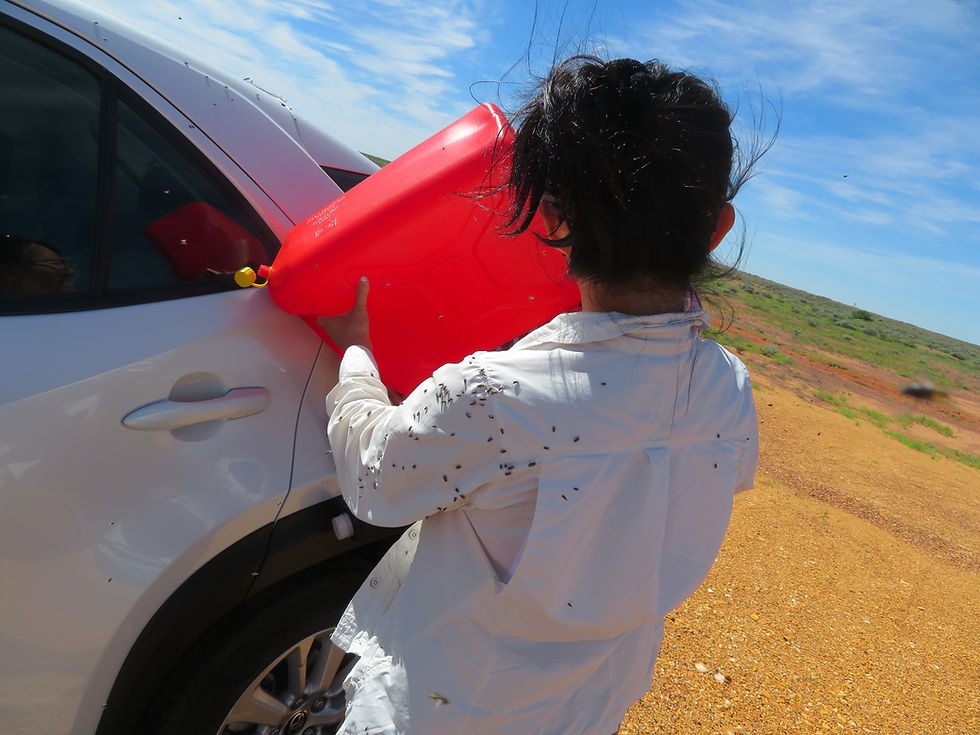
Coober Pedy (CP), our last major destination, required backtracking southwest to Port Augusta (PA), where one gets on the southern end of The Stuart Highway, and then drives over five lonely hours northwest, halfway to the border with the NT and Alice Springs /Uluru (too far for us). Once on it, we expected to see true plant-less outback terrain. However here too, there was much more greenery than expected (only in part due to the unusually-timed rains that had hit SA and actually flooded out some crossings, closing dirt tracks of interest to those more adventurous than us). What was true to expectation was the lack of settlements or gas stations. Thanks to Israel, Trump, and Iran (by the way, this has to be the first time in human history that two countries that share neither a border nor a common colonial/resource interest are at war- when you delve down to it this is just about who has the better Imaginary Friend- a new low bar for human stupidity), there are rumours of shortages in some Australian cities (and outback prices up to $2.99/L! with 1AUD=~1CAD), so we filled up whenever possible- so what is JC doing, covered in flies, pouring gas from a canister into a stranded car?
We spent the night mid-way in one of two units on the Wirraminna Cattle Station- which has land holdings of ~3000 sq km, including its own salt lake (Lake Hart, did have a shallow covering of water, as did all the many salt lakes we saw in SA), greeted by host//station

manager Stacey's dog, Xena, who joined me on a jog further down the dirt road, with rusted metal of all sorts and glass strewn along the sides. An hour earlier we had stopped to see the museum at Woomera, the only true town, and 1 of only 3 potential gas stops on the stretch, home to a U.S./U.K. missile testing site and next to the England-sized Woomera-prohibited area. The next day we were surprised to find out that there were no gas stops at all on the 2nd half of the 534km stretch from PA to CP. Good thing we had filled up in Woomera! Then, getting back into the car after a quick break, Leonie, a solo lady from the Netherlands pulls up next to us and frantically rolls down her window wanting to talk!
With 90 km to go to CP, her car's range is down to 63! She hadn't filled since getting on The Stuart at PA, when her range read 734km, and she hadn't paid attention at the intervening roadhouses. Hoping that there would be a considerable buffer and the range reading would go down more slowly at the end, I suggested that she get back on the road, drive at 90 km/h for best efficiency, and that we would follow behind her, and speak after another 40km distance. But after 35km, she pulled over and informed me that she was already down to only 15km- not looking good. I told her I'd stay behind her until she ran out, however soon the shoulder became unsafe, and she pulled over when next possible with only 2km left. She put a dated note on her car and got into the back of ours, next to a stack of 2 of our 7 tires (story far below, if interested). She was very thankful to us and tried to apologize for the inconvenience, however we replied that a true Outback adventure and interesting conversation was exactly what we had come for! We soon made it into CP where I filled up my tank and she purchased a 20L canister, filled it, and got back into our backseat for the ride back to her car, without further incident. What we don't know is how much further she actually could have gone. Her SUV's range read 2/3rds full after only 20L, and why wasn't the quoted 734km range at PA fill even close to accurate? Maybe it was just another (again, see story far below) sensor problem all along? Better not to have found out.

When we first were planning the SA portion of our trip, JC's aunt had asked us not to go to Coober Pedy, telling us it was creepy and that there was nothing there.Having not heard of it before, anyone who knows me can likely figure out what happened next. I did not plan to go there just because she said not to, but must admit that it piqued my curiosity in learning more. My old Lonely Planet described it as one of the major stops on, and highlights of, The Outback, and the internet agreed. I asked our future Kangaroo Island AirBnB host her thoughts, and she told me she had just visited and greatly enjoyed it, giving us confidence in going. The remote 1916-discovered opal mining center of the world, with over 1.5 million open shafts, can get so hot in the summer (it hit 49c this January, when Adelaide reached 42) that most people actually live underground in "dug-outs" from the hilly sandstone terrain, often where they are mining. Staying in one (we did, with all modern home conveniences present), or just visiting is a highlight. Just seeing the town of ~2000, with mining trucks with huge vacuum blowers and collecting buckets attached, as well as other strange and rusted metal contraptions littered about (why Mad Max was filmed here) is another. For the careful visitor, safety is really not really a concern. Part of its reputation is historical, but alcohol is still carefully dispensed, and the strange separate unsolved disappearances of two solo female travellers in the 1990s hangs over the town.

The birds of South Australia are one it it's highlights with sightings including multiples of pink galahs, rainbow lorikeet, many black swans, a scarlet robin, rosellas, superb fairy wren [voted A's favorite bird], Australian shelduck, Aus magpie, sulfur-crested and yellow-tailed black cockatoos, Major Mitchell's Cockatoos (now being renamed pink cockatoos in part due to the major's role in a massacre of Aboriginals), Austalian white ibis, red-rumped parrots, wedge-tailed eagles (slightly larger than Bald eagles, one of which was so bold that he refused to budge from his Stuart Hwy outback roadkill claim as our car whizzed by in the other lane only ~2 feet away! We were later told that there is a danger of them taking off at the last minute, colliding and busting windshields. Sadly and upsettingly, I must admit to having likely killed a much smaller bird who took off last second from the opposite lane and went right at me- I took my foot off the gas, but didn't have time to break, and he glanced off and then over our windshield. I don't recall having likely killed a bird before. I was speeding slightly. On our few sunset or later drives we intentionally kept our speed down to 70km/h in the 110 zones for fear of kangaroos or wallabees, which much more commonly hop suddenly across the road near/after darkness), Australian Ringnecks, emus, swamphens, tons of huge pelicans and other shorebirds.

The kings of the Stuart Highway, and much of Australia's other highways, are the road trains. These are 2- or usually 3- connected full length trailered trucks (we saw a few of up to 5 trailers- not sure if they were legal, which seems to be a function of total length) speeding close to the standard 110 km/h limit on the 2-lane highways. Passing them is quite an adventure- 1km distance is suggested. Don't try if there is a curve as they will sway into the other lane.
However the true rulers of the continent are its flies. Although not too bad along the coast, in Riverland, and especially the Outback, their numbers were spectacular. I counted 81 on JC's sleeve/back in the above photo. We frequently had to wear our bug nets (once even when I went for a run in CP), which although always travelled and hiked with, I don't think have actually been worn since last in Australia in 2010. Even taking a quick bladder break roadside without putting one on was impossible. As was sneaking back into the car without several getting in. We had hoped that they wouldn't be so bad this time- our prior trip was

in Aussie spring, while this one was early Australian fall, however that was not to be. Could it be from the unusually-timed rains a couple weeks earlier? Several said so, however I suspect that those who told us there are always flies are being more truthful. They really do detract from many otherwise fantastic outdoor experiences in the country. Surprisingly not a single snake was seen this trip (after seeing multiple in 2010, we even brought gaiters for hiking, though never put them on). Also no dingoes, which was a concern for me after the recent tragic death of a Canadian 19yo girl out for a morning jog on Fraser Island, given my enjoyment of running on deserted beaches. It ends up that there are very few of these where we were, in part due to the 5614 km dog fence, constructed at first piecemeal and privately to protect sheep, then later connected together by the government.
Well that is about it for the educational portion of the Australia blog. There is a link to my blog from our 2010 trip to West Australia and Sydney for anyone interested below this paragraph. What follows afterwards are a couple of stories of traveller's hassles, so feel free to stop here if not interested. One relates to difficulty getting visas for Australia, and another, once again, to rental car difficulties. Although as I am currently on hour 5 of an early arrival for our flight out of Fiji, delayed, but as of yet not cancelled, by a Category 3 Cyclone, so I guess I will need to write a bit about what was intended as a short stay of just relaxation in that country as well...
a link to our 2010 West Australia / Sydney trip:
...a couple hours later- now 1:20am -others flights have left- and our flight's story is no longer making sense-I suspect they will announce it is cancelled shortly...regardless, I have nothing to do right now other than resume typing...
Australian Visa Hassles:
We knew ETA visas were needed for both of us, but largely viewed this as a formality. In fact, back in 2010 we were so blase about the formalities of going to Australia compared to where we had been in recent years, that we actually didn't realize we both needed visas until arriving at the airport in Kuala Lumpur! The agent told us to get on the computers in a back room, and sure enough, within minutes, we both had visas and were ready to board. This time we thought we were prepared, and got online about a month in advance to get our ETAs.
My visa arrived within seconds, however JC's did not. She is still a citizen of Malaysia only, as they do not allow dual citizenship. A few minutes later another email arrived, requesting a laundry list of additional information. Not only a precise schedule of arrival and departure, travel destinations and accommodation stops (we of course had about a dozen of these) and reasons for travel, but also employment records, financial records, and even a list of who her family members were! Alarmed, she posted on her family chat- and instantly got back several replies of members experiencing similar problems. It seems Australia has issues with Malaysians entering the country on short travel visas, then outstaying their welcome and working picking apples. A cousin mentioned that at first she was also selected for secondary screening, throwing everything including the kitchen sink into the document. Another had to go through a travel service. Her brother-in-law's secretary pulled her hair out trying to get him one for business travel. Parents of 2 kids both starting college in Australia were also initially rejected.

Furthermore, searching online seemed to imply that at this stage the usual wait was up to 28 days, which would not give us enough time to arrange alternate plans. Our expensive flight home via Fiji was non-refundable, and most of our accommodations would soon go beyond their refundable dates, forcing us to get ready to cancel them. JC spent literally the entire next day getting her documents together (of course there were technical problems as well with their site for this). We spent the next few days cursing the Australian government, however then 3 days later, in the middle of the night Aussie time, her visa came through! I think what may have saved us was a question about whether she had ever had an Australian visa before, which may have fast-tracked her, keeping her in an AI-determined algorithm, rather than getting booted into a human-evaluated line, explaining the middle-of-the-night acceptance? So for anyone, especially Asians, planning a trip to Australia- get your visa before booking your flight if possible...
Car Rental Adventures: Carrying Seven Tires for Four Wheels.
We rented a small MG3 (a cheap but decent Chinese brand since 2005 buyout of old MG classics from UK) from East Coast Car Rentals in Adelaide, picking it up the next day as our 10pm arrival from Darwin was after hours for Adelaide, with only a couple of companies offering anything at that time at an additional cost of almost $2000 for the 20 days. It drove rather well once I got used to its strange and non-intuitive display controls, requiring pushing a certain order of generically marked buttons in order to change screens or adjust functions. A few days later, after taking the ferry back from Kangaroo island and heading towards The Coorong, a warning light came on stating that our front left tire pressure was low. I didn't think much of it, as I have seen this come on multiple cars, usually meaning either nothing or just that some air needed to be added. I seemed to vaguely recall seeing that that tire had a somewhat lower number than the other three the first day of driving when the display screen got stuck on a display showing only tire pressure and no odometer measures, until I managed to somehow change it back. With still several hours of driving ahead that Thursday afternoon, we pulled into the nearest gas station, and with help (needed as although I thought I was using the pump correctly, the measure of 31.9 psi did not change at all- the station manager confirmed we were doing it properly, and after a few minutes of driving it reset- now ~45psi, others ~37) filled it up.
Ninety minutes of driving later, reaching a more remote area parallel to and just inland across marshes from The Coorong NP, we came upon a beautiful white/pink/red-hued salt lake, with an SUV stuck on it having gone off-road intentionally. Wanting at least a photo, I pulled over and walked out to the car over the at first hard crusty salt surface, becoming somewhat softer as I reached the car~100m into the lake. Its wheels had buried themselves deep in the mud and clearly a push would not suffice. The driver, a solo young Chinese student who admitted to looking for some fun off-road, however did not seem at all concerned, he told me he had already called roadside assistance and they were on their way. Minutes after restarting our drive the same tire's pressure light came back on- again at 31.9psi. Was this just a sensor issue or was something real going on? JC and I both had the same thought- on our bike ride with Uncle Tom, he had warned us about going off onto the trail's shoulders because of the abundance of what we thought he called "three-quarter jacks" thorns that could easily puncture our tires (spiny emex, he actually had called them "three-corner jacks", but in true Aussie style, they are also referred to as Doublegee, Goat's Head, Goat's Head Burr, Cat's Head, Bullhead, Prickly Jack, Jackie, Devil's Thorn, Devil's Face and Cape Spinach). Had one gotten our car due to my habit of pulling over for photography or physiology?

Only minutes later it pinged again and was down to 31.3 psi. It was now after hours, and we had just passed through a very small town that had a gas station, and had about 130km left to our destination of Pink's Beach with no other towns until Kingston SE (southeast, differentiating it from another Kingston elsewhere in the state) 10km before it, at the far end of The Coorong. A further ping, and it only read as 'low", no longer displaying a number, although it looked visually fine. Some quick math and it was clear to me that we wouldn't make it if the apparent rate of decline was real. I instantly decided to pull a U-turn and go back to the previous town, with its closed gas station and hope it had an air pump. It did. We pumped it until the meter read 45, although the car, after taking a few minutes to reset, only read 42psi. At this point I had figured out how to adjust the displays properly, and just left it on the tire pressure screen. A few minutes later it notched down to 41.4, and after another 5 min, 40.8. It seemed to be following a linear rate of decline- always notching down by 0.6psi about every 5 min or 10km. If the rate continued, the math suggested we would get to our AirBnB right around the moment the 32psi alarm threshold would be reached. Figuring that even at that level the car would be safe to drive for a while, I became increasingly hopeful we would make it. Indeed the same rate of decline inexorably continued, and we pulled on to our front lawn parking at about 33psi. No more driving needed, but what would the morning bring?
Sure enough, on looking out at 9am, it was almost completely flat- not at all drivable. I needed a bit more sleep, but JC had texted our host who suggested Stephen Edwards at Edwards Auto repairs in Kingston SE. She called him and he informed her no one would be open either weekend day, but that they were open all day today, friday. If we needed them to tow it, that would add another $100. She wanted to deal with things right away, but I insisted on taking my morning beach run and swim. I told her that afterwards I wanted to try to put on the temporary use-only spare myself, not having done so solo in decades, and feeling the practice would be useful before heading into the outback. After some great exercise on the empty beach, I got to work. An hour later it was done. I had made some minor mistakes in technique from which we learned, and was now confident I could change one in 25 minutes should the need re-arise. We drove to Stephen's and walked around town (Kingston SE is home to the world's largest lobster statue, roadside, but unfortunately lobster season had ended and the stores were all sold out), while he checked the tire.

Shortly after returning, he came out shaking his head. He had already informed us that our tire size, 195/55 R16, was unusual and he didn't have any in stock and doubted anyone else nearby would, so we were forced to bank on something fixable. He showed us that they had found a small gash in the sidewall of the tire- a location that cannot safely be repaired (and would not have been caused by the three-corner jack, could it have been slowly leaking from when we first picked up the car, and just enlarged more recently?) - the tire was junk. He would not be able to get us a new one until Tuesday- it was already too late on Friday to get it in for Monday's orders from Adelaide (population 1.3M, the only city in all of SA of more than 25K). In addition to hoping to tour the region the next day, we had a 3-hr, 300km drive planned to Riverland on Sunday. He suggested we check the other auto shops in town, which I asked him to call for us. The one across the street did have a used one- however it was in poor shape and only a temporary fix, with their mechanic suggesting we put no more than 50-100km on it before getting a new one put on. I drove across to pick it up at no cost. The mechanic there picked a small piece of metal off the thinning tread, marking that spot and suggesting that Stephen test it "with bubbly" (done-it passed) to be sure it wasn't already leaking before putting it on, though his co-worker commented it may be able to go further- maybe even 1000 km.
Now that we had a workable short-term plan, we called the rental company to see what they wanted. As we hadn't purchased insurance, they wouldn't pay for the tires (my credit card has CDW insurance, however I later found out that this only covers a flat if it occurs as part of an actual collision), we could bring it in and they would give us a new tire or car, however dependent on availability. So we decided to call repair shops in the towns of Riverland to see if any had the tire size needed in stock,.or could at least get one by Tuesday morning when we would be driving on again. As Stephen suspected no one had it, but on our 3rd and last available try, Jake from Riverland Tyrepower in Renmark promised us that he could get one in on Monday and have us rolling first thing Tuesday morning for $150 (by the way the Aussie dollar has been gaining against the CAD, and after exchange fees they are now functionally at par). Stephen only charged us $50 for his shop's labour, and his mechanic felt more confident about the tire itself. We ended up putting about 500km on it, including maybe 40km on dirt roads, without problems, so asked Jake to save it for us, putting it in our back seat (JC had prepared plastic bags to wrap it in) as an option beyond our small spare for possible flats in The Outback.
The next morning we were in the mid-north mining town of Burra, staying at a historic cottage a block from the town center. Thunderstorms had rolled in overnight, with some seeming to rumble endlessly across the plains, and it was cold and pouring when we loaded the car. Not even 2 blocks after heading out, the low tire pressure alarm went off again- a different tire, this time rear right, 31.3 psi. Exasperated and worried, we U-turned and pulled into the gas station to pump it up and inquire about our options. Burra Tires Bridgestone was just 2 km away. By the time we got there our rear left tire was also at 31.9 and alarming! They felt confident that it was just a sensor problem, they had seen no less than five of these in recent days, and would check it out for us. Sure enough that was the case, however the mechanic there found that the tread on our rear left tire was "barely legal", and felt that we properly needed two new tires as well as a wheel alignment. He had our size in stock. The tire change would be fast, but wheel alignment would take a few hours.
What to do? The tire was still "legal", and tire shop mechanics make a living out of finding borderline issues, however the rains were continuing, and we had a long drive up to a remote area planned, and maybe 2000 km total mostly in The Outback to go. We felt that this problem really should not be our financial responsibility, and called East Coast Car Rentals. Daniel from Burra Tires spoke with them, and they authorized one new tire, stating that we should pay for it and they would refund us upon vehicle return. A resolution that we were happy with- wheel alignment could wait, and we would be rolling again quickly. Once again we asked to keep the old tire, and stacked it on top of the other one in our back seat alongside our day packs and groceries. So there you have it- seven tires in our small car as we headed into the Outback!

Driving was smooth the rest of the way, and on returning the vehicle, Lufi (by chance the agent who authorized the new tire), promptly reimbursed not only the $232 for the second new tire, but also the $57 for the sensor check and reset. We actually ended up being quite happy with East Coast Car Rentals, unlike our recent El Salvador experience, or what awaited us in Fiji.
Fiji and Cyclone Vaianu:
Fiji Airways started non-stop flights to Vancouver late 2022, and when we started trying to figure out how to get back home from Australia it was clearly our best option- either just a transfer in its main airport of Nadi (pronounced Nandi), or an actual stop there. So why not a few days of sunshine, snorkeling, beaches, relaxation and a new country for Jiak Chin? I had spent a week there as my last stop on my first around-the-world exactly thirty years earlier. What we got, however, was Darwin-revisited and much more. Four rainy days, and then...

Fiji is a nation of 332 islands which together are about half the size of Vancouver Island, but cover a total ocean area double the size of France, with a population of about 1 million, with most of both being on its two main islands, Viti Levu (which we visited) and Vanua Levu.
We arrived at 9pm, however the meet and greet for our EconomyBookings car rental subcontracted by Rental24 did not show up, and no one was answering the phone contact number provided. I will spare you all the fine details, given that you likely have read the above megillah if you have actually made it down to here, however after about half an hour helped by the last on site rental (who was out of cars) we made it through to Mursah who claimed that he actually was a sub-subcontractor named Baker's Car Rentals (true), and that he never was provided with our invoice, and had no way of getting us a car or ride that evening (highly unlikely), suggesting that we take a taxi for the 1hr/$80CAD ride to our AirBnB, but refusing to pay for it, saying we should contact Rental 24, apparently based out of Istanbul (yet to hear back after filling out a form with Economy Bookings). He did deliver us an "upgrade" to a clunker of an SUV the next morning. Our helpful taxi driver, Riaz (who, when checking in with on departure five days later, was pleased to inform me that he hadn't smoked since our talk!), commented that this is a recurring problem with Rental24.

Our ambitions were limited, as was sunshine, although each day had a couple of rain-free hours. We managed to get in some very good snorkeling right off the shore on the south-side Coral Coast (now post-trip, JC just informed me that the government has just issued a box jellyfish warning, precise locations not stated!), where I got applause for finding the dropped bracelet of a young girl in chest-deep water below the jetty, and I also got a great run on an empty beach below the impressive sand dunes of Sigatoka. We walked through a couple of small villages, and were invited to poke our heads into one of the homes where a family of about 15 were sprawled on the mats, sharing an Easter meal. The locals are very friendly and helpful- several times briefly becoming our impromptu guides.
The population is split between Polynesian " iTaukei", literally 'owners [of the land]', who are Christian (after unsuccessful wars to resist, ~1850s), a slight majority, and more rural-based, although owning some of the resorts along with foreigners, and Indo-Fijians. The latter, 75% Hindu, 25% Muslim (although everyone we met seemed to be Muslim, and AirBnB caretaker Razia, who cooked us a fabulous meal while telling us her difficult personal history, thought it was about even) are descendants of Indian contract labourers brought to the islands by the British colonial powers in the 19th century to work sugar cane plantations. The latter's election victories have led to a number of coups, although things have been quiet for over a decade now.
Our last night I checked the online weather radar (there were no alerts on accuweather's hourly or tomorrow pages, and the numbers didn't seem concerning- wind speeds in the 30 km/h range, although gusts up to 78 km/h) and was surprised to see what looked like a hurricane west of Fiji. At first I assumed that it was just the rain we had experienced, and that, similar to the storms in Darwin, it would continue to move further west, away from us.

However on checking the gov't's site and a cyclone tracker, I became somewhat concerned- it was indeed a cyclone (the southern hemisphere's designation for a hurricane/typhoon, but spin clockwise) named Vaianu, currently category 2, but expected to strengthen to cat. 3 the next day, and although not expected to make landfall (thank Darwin!), it was heading closer and a direct hit was still in the forecast path's cone of uncertainty (where was president Trump with his all-powerful sharpie when we needed him?). It was moving very slowly southeast, currently centered 380km away from Nadi (which is the western-most point of the roughly oval-shaped island), but would be as close as about 250km away the next morning... No, Wait- in red in the upper right of the chart: "all times in UTC"! Twelve hours behind Fiji time- so Vaianu would be at its closest right when we were supposed to take off, 10pm the following evening!
Cancellation seemed quite possible. Of course the more important, although much less likely, danger would be taking off amidst a miscalculation of the situation's risk. Fortunately, because of the very late flight time we had booked a very cheap, poorly-rated, resort room for $53 near town (about a 2hr, 100km west and north drive from where we were currently-towards the cyclone), so that we could have a swim, nap, shower, eat dinner and use the facilities before going to the airport. Now it represented a potential place to stay the night, check-in after 2pm.
The next morning things seemed as expected- it had followed the expected path, although picking up speed. It was raining out, but not particularly heavy or windy where we were. We hadn't heard anything from our hosts, nor any updates from Fiji Airways, with our flight still listed as "on time". The Fiji Meteorological Service (which, as I type several days later, now shows a week of nothing but sunshine forecast!) was posting heavy rain and possible flooding alerts for near Nadi. We headed out late morning, planning to visit Natadola Beach, about mid-way to our new place and voted the world's most beautiful outside home by New Zealanders, but confusing directions, increasingly heavy rain, with pooling along roadsides, led to me finally yielding to my wife's wise counsel after a few wrong turns and now a less reliable-appearing road.

Back on the Queen's Highway, the weather continued to deteriorate as we drove closer, with both wind and rain picking up,and in band-like bursts limiting visibility and lasting about a minute each as we drove. Thunder and a bit of lightning. Then a couple of bending, wind-blown, roadside palm trees, looking like a weather channel documentary. Our car frequently swayed with the gusts, and at this point we were glad to have been given the "upgrade" from small car to SUV! Then suddenly, in a more exposed, slightly elevated section, debris flying horizontally across the highway- tons of it like in a tornado!! All small, mostly leaves and twigs, at least from what I could notice while keeping my eyes on the road, but getting very scary! I kept going and fortunately the debris storm lasted only a few seconds until we had passed through that clearing. I began to wonder if it was safe to remain on the road, but figured that things could be getting worse as the afternoon progressed, and we would be safest if we could reach our hotel. There was no shortage of other cars, and even some locals walking roadside.
Maybe a minute or so later the road, now back in a forested area, became littered by several medium to large leaf-covered branches, forcing us frequently into the other lane to get around them. Then suddenly a small car coming the other way flashing his high beams at us- clearly a warning of trouble ahead! Seconds later we saw it- a large tree fallen, its two, still connected, parallel fork prong-like trunks spanning the entire road, each maybe a foot in diameter, with thinner branches and leaves obstructing the far shoulder! "We're done!", I exclaimed, seeing no way through. We wondered how the car had made it- had it been falling just as he passed (we were the first car on the scene)- or did he somehow squeeze around it- seemingly impossible.

I got out to look more closely, at the far end there was a bit of space beyond the shoulder where a driveway came in, but one side was hemmed in by a large wooden barrier, and the other consisted of the upper tree branches- it was probably too narrow (and I also didn't see any evidence of the other car having crunched over it). Then I saw a local walking down the road from behind the tree. He was carrying a machete. Before I could say much, he said we needed to chop it (it was so thick-was that possible?), and started to do so. I helped him pull some of the smaller branches he started with away from the road. Soon several trucks and cars had lined up behind us, and others came out to help. Ratu Viliame (my name for him as of now: King William) was now working on the main trunks and making obvious progress.
Ratu Viliame clearly knew what he was doing- had he done this before? Fiji was hit by category 5 Cyclone Winston in 2016, the country's worst recorded natural disaster and the strongest storm to ever make landfall in the Southern Hemisphere, killing 44 and destroying or damaging 40 000 homes.
While it is not clear if the frequency of tropical storms hitting Fiji is increasing, their intensity clearly is.

Less than five minutes after I had hit the brakes, the road was 100% clear and we were rolling again, thanking Ratu Viliame, and giving him a thumbs up as we passed. Over the next few minutes, there were quite a few other partial blockages with locals working on them, but nothing else that blocked both lanes. We marvelled at the skills and do-it-yourself attitude of the Fijians. In the West this would have been a call-the-authorities and wait several hours for them to show up situation. Soon we were on the outskirts of town, and filled up with gas. Bridges we crossed were fine, but flows were fast and full of branches. JC had seen a facebook post about some flooding at a round-about, however it ended up not being on our route, which did go into a more rural area behind the town, with some partial obstructions, and just the single road into our resort.

On arrival the desk was unattended, with just one other traveller (also staying until a late flight, with an 8pm taxi booked) telling us the clerk would be back soon. The resort, and especially its great pool, seemed deserted. Although I would have braved the rain, I didn't dare swim with the risk of tree branches flying and occasional lightning. The large covered reception area was getting wet with some blowing rain. Their system was down, but eventually we got checked into a partially made-up room at about 2:30pm. We still hadn't received any changes from Fiji Airways, so started checking flight tracker websites. We found that all domestic flights were cancelled, but only about half of international ones (although many of the others had delays-generally until around midnight), with some recent landings having taken place. Ours was still scheduled as on time. Minutes later an email came through stating that we were delayed until 11:50pm, with the tracker websites seeming to update instantaneously. So it seemed we really would be going!
Our concern now shifted to getting to the airport. We had scheduled a 7:30pm drop-off time for the car, however we were concerned about both driving in the dark (~6:15pm), and also the possibility of the lone road to our resort getting cut off. It seemed there were only 2 employees at the understaffed resort, and we didn't trust it to be as effective as Ratu Viliame and the other locals in removing potential obstructions, not to mention risk of flooding. We decided to stick with our adjusted plan of going before darkness, despite the long airport wait such implied. Looking outside our large window was like watching CNN. Every minute or two there would be a loud gust of horizontally lashing wind and heavy rain obscuring the view. The resort's system was still down, and after only a 3-hour stay, the clerk told us to just go- as yet no charges have shown up on our card.

Roadsides were partly flooded, but we easily passed the areas with tree branches of concern, and both small bridges were fine. The precise drop-off location for our car was at a flooded T-junction, so the rental company's guy (who showed up- we reconfirmed a couple of times) met us a block away, and drove us the very short distance to the terminal, including through one especially noteworthy area at its entrance with a flooded depth of maybe a foot, with a fast driving exiting SUV sending water spurts well above the roofs of both vehicles.
Inside the airport things were quite calm. Several flights, all Fiji Airways, were still scheduled to go, and our timing was unchanged (it ended up that one flight coming in from Australia had made three unsuccessful attempts at landing before being diverted to Tonga. The airport at capital Suva, on the far west of the island, is too short for large planes). Frequent power outages were repeatedly solved in seconds with a clapping employee pretending to activate the reliable generator. Enjoyable conversations with Solomon from Victoria, in the middle of what was supposed to be an only 43hr jaunt home from NZ. We went through security early so I could work on parts of this blog in peace. Our plane was already present, having flown in that morning.
However time flies when I'm mentally occupied, and writing these are indeed time-consuming. Soon it was approaching our 23:05 boarding time and, other than the common gate area having become a lot more crowded (I think there were 6 flights still on, all scheduled for around midnight), not much was happening. It seemed further delays were inevitable, if not unexpected. No announcements. No way to see or hear what was going on outside. No emails or changes on the internet sites, although the area's departure boards were clearly not being updated- still showing 10pm for us, and similar nonsense for the other flights. Approaching midnight some staff showed up to the desks, and I spoke with one who told me the storm had passed, and that they needed to get our meals loaded, after which the crew would go on to do checks, and boarding would then commence.
Soon announcements started, mostly for the other flights, but all stating the same thing, the flights were delayed for catering reasons. Not much later, however, three of the flights started, and completed boarding, and presumably had taken off. At 1:20am we still only had occasional announcements still stating that there was a catering delay. Over two hours to load the meals? Why was our catering situation different from the others? Something seemed wrong. I soon spoke with another passenger who was told something about lightning (so the cyclone wasn't over yet...) and the possibility of the pilots timing out at 3am. This was beginning to sound like our San Francisco/United disaster (read "High Rise Fire" under Odds & Ends if you can't resist knowing the details)- I started to doubt that we would be flying that night. Why hadn't they just cancelled to begin with, so we could have at least relaxed at our resort? On the brighter side, we had asked the resort to hold our room in case things went sour, and (unlike in SF) at least the plane and crew would still be there, presumably for another try the next day.
Around 2am, after more announcements about catering delays, I went up to the desk, and finally got a story that did fit together: there were intermittent weather alerts due to lightning, and each time one was issued the catering staff would have to exit the plane until it was rescinded. Timing out would indeed occur if we weren't moving by 3am, however another set of pilots were apparently available in Nadi, and we would eventually be going either way- no need to wait for these pilots to have their sleeps. Furthermore, the crew was now ready to go on board to do their checks. Sounding hopeful! Minutes later the same more detailed explanation was announced overhead for everyone to hear. Soon they started preparing the passengers who needed wheelchairs to board, and although another catering delay announcement followed (I thought that had been completed?), those passengers soon disappeared down the ramp! The rest of us started boarding around 2:40am, and shortly after 3am we were ready to take off for the 11hr flight! I don't recall much wind or turbulence on, or shortly after, take-off, and the rest of the flight was smooth. Despite our early airport arrival and the total delay of 5 hrs, our door-to-door time of 22hrs was still a bit shorter than the usual trip home from Malaysia!
So Jiak Chin and I have now had our cyclone/hurricane experience. If this was a near miss, we don't ever want to experience a real hit!
a report I just found implies that it had actually got much worse than we realized, although what they say about the airport is inflated beyond what we experienced, and some of the more dramatic statements are without visual documentation:
(skip to 7:40 for machete tree-clearing like our experience)
Reporting today states there were no deaths in Fiji- again, thank Darwin!
Until Next Time,
Stu

Thank you, Stuart and JC, for sharing your journey with us. It was both informative and full of genuine laughter, and I could easily imagine listening to you both in person. Wishing you both well. Keep travelling and continue exploring the world.👍