
High Rise Fire !!

Updated: Apr 17

We had instantly fallen in love with the 10th floor Penang condo! We were now thrilled to have arrived back at it a couple of days earlier, and it had begun to feel like a second home to us. It was May 2023 and our third stay there, all in a little over a year, since Malaysia's harsh COVID restrictions had finally been relaxed in the spring of 2022. The three and a half year gap since Jiak Chin's prior visit home to see her aging parents, and large extended family, had been the longest since her pioneering student years, and had been very emotionally trying on all. Her Dad's long-planned 80th birthday celebration had needed to be turned into a Zoom event.
The condo was owned by JC's sister, and part of Penang's Sri York Condominium complex, in a coveted location just outside downtown Georgetown [the island's principal city, with many unaware that it has a name other than, the more commonly spoken of, "Penang" itself]. We actually had been staying elsewhere in the mid-range complex, at rental units, ever since my first visit back to Penang, when I met JC's parents for the first time in 2005.
I had been to the city on my solo travels in 2000, arriving via an exciting, partly open-aired, fast ferry across the heavily-pirated shipping lanes of the Strait of Malacca, from Sumatra. I recall having been very taken by Penang's tri-ethnic cultural heritage, intricately-carved temples, and resulting gourmet delights. However, always wanting to explore somewhere new, with Malaysia having been country #50 for the then 32 year old physician about to start his practice several weeks later in Vancouver, I couldn't imagine any reason for return trips to Malaysia. However, not long after starting, I stopped to speak with one of the Diabetes Centre's dietitians, running into her in front of the hospital, after crossing Burrard Street from my office. Our topic of my international travels was clearly of significant interest to her. She gave me a strange look, and I knew I was in trouble.

The Sri York complex suited us perfectly. It was only about a seven minute walk to her parents home. very close for her, but not too close for me. Furthermore, the walk went through a small park that included a building housing a table tennis club, where her father would play after work. I had started to join him on some afternoons in more recent years, although I was far below his level. Additionally, Sri York had a large, beautiful coconut tree-lined courtyard swimming pool, where I could swim in the mornings, while JC was off visiting, or doing errands with, her parents. Things couldn't have been better. Costs, like everything in Malaysia for those on foreign currency, were very low, and we had upgraded our stays to a three-bedroom unit, because of a better kitchen and dining room. The visits had become increasingly frequent, to almost yearly, when the virus struck.
Jiak Chin's sister had purchased a condo in the complex about a decade earlier, which she, living in Malaysia's capital of Kuala Lumpur, at least several hours drive south, rented out. When her tenants moved out early during COVID, she initially opted not to look for replacements. With us hopefully planning a long stay for the sisters' year apart, same-day, birthday, September 2022, she agreed to try to keep it vacant at least until then. Of course, at that point in history everything was coronavirus-contingent, and when we had a couple weeks off in May at the very moment when international travel to Malaysia was first opening up, we decided to jump on the opportunity. We knew full well that circumstances could easily deteriorate over the summer, with significant potential for reinstituted travel bans prohibiting our fall trip. Additional, albeit less crucial, good fortune smiled on us when the logistically cumbersome requirements for pre-flight viral tests and post-flight quarantines ended up being eliminated a week prior our trip.

We rapidly came to love the condo. In addition to all the above- mentioned advantages of location, it was a unit where we could truly feel at home. On the 10th floor, it faced south, and was just above the canopy level of a dual line of large trees in the narrow, but elongated park extension behind the complex, through which ran a small branch of the Penang River. This meant that it had a 180- degree, essentially unobstructed, view of the south of the island. "When I saw it, I was amazed..." for me a

meaningful line from "Soul Survivor" by Asia, a song that I now regularly listen to while doing jumping jacks alternating with shadow boxing on the balcony]. The panorama spanned from the Komtar Tower in the east,
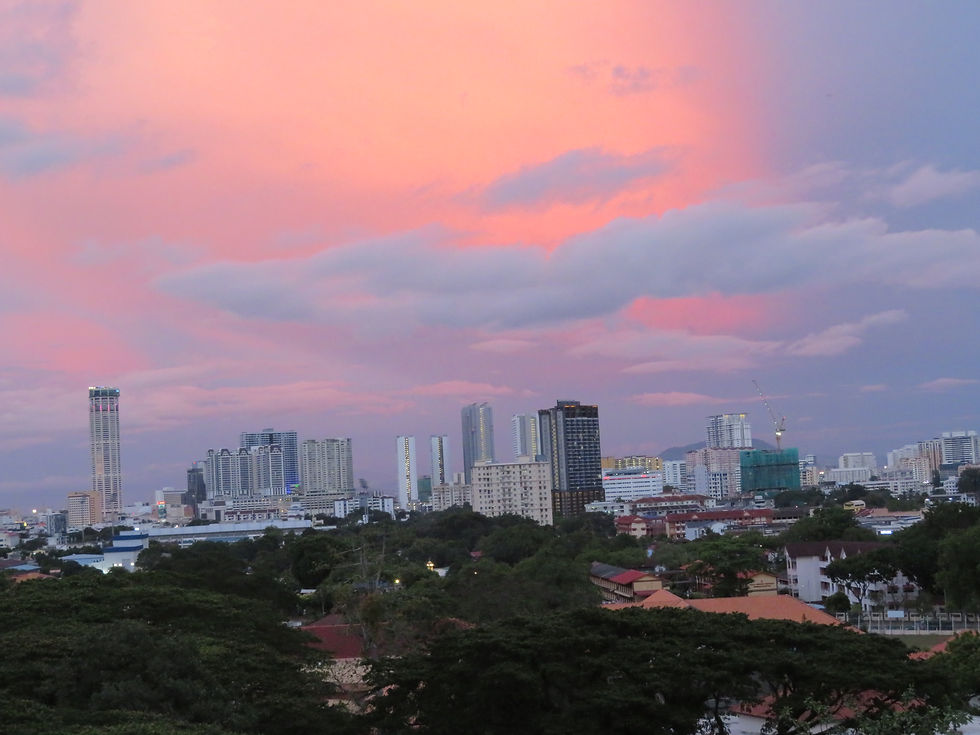
to the Penang Hill mountain range and the Kek Lok Si temple in the west, with clusters of high rises at various points in the distance as the view arched in-between. Komtar, opened in 1976, was the tallest skyscraper in Southeast Asia at 232m at the time of its completion, and surprisingly remains the tallest in Penang to this day. Multi-pagoda-ed Kek Lok Si, with its beautiful gardens, is the largest Buddhist temple in Malaysia, and is an amazing sight, especially when lit up with thousands of colourful lamps during the Chinese New

Year period.
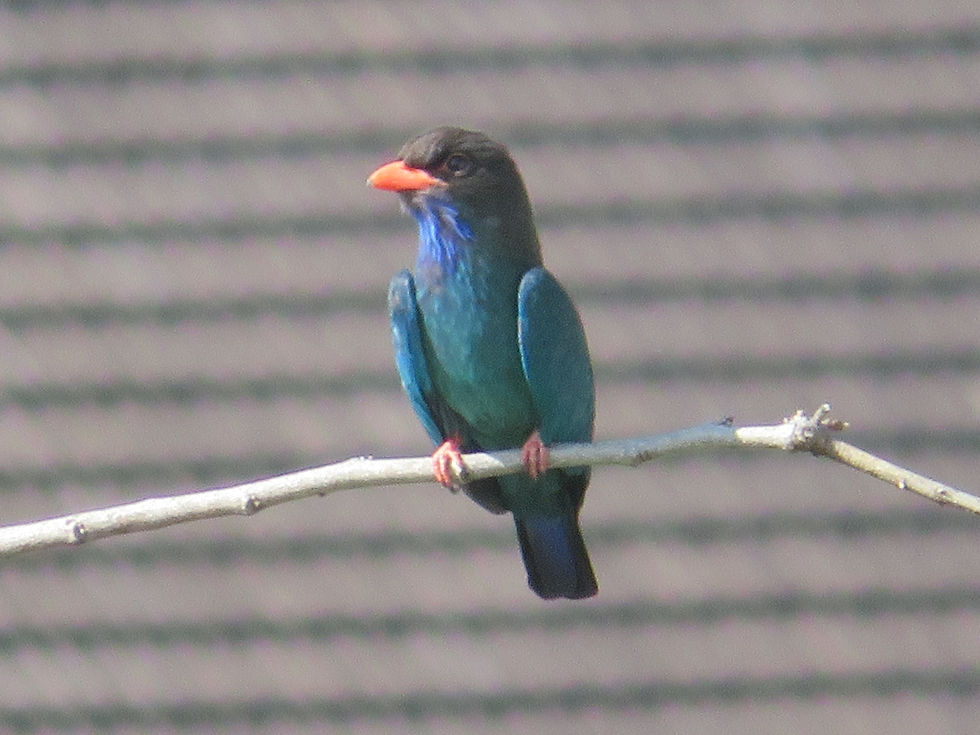
The tree-top canopy, and the view-obstructed river below, make the condo's balcony a perfect site for bird watching. Highlights have included close-ups of pink-necked green pigeon couples, common and javan mynas, glossy starlings, black-naped orioles, swoops of swallows, soaring Brahminy kites and fish eagles, crows and egrets. Walking below, neon blue-winged [but poorly named] white-throated kingfishers are a common sight, while racket-tailed drongos are rare ones.

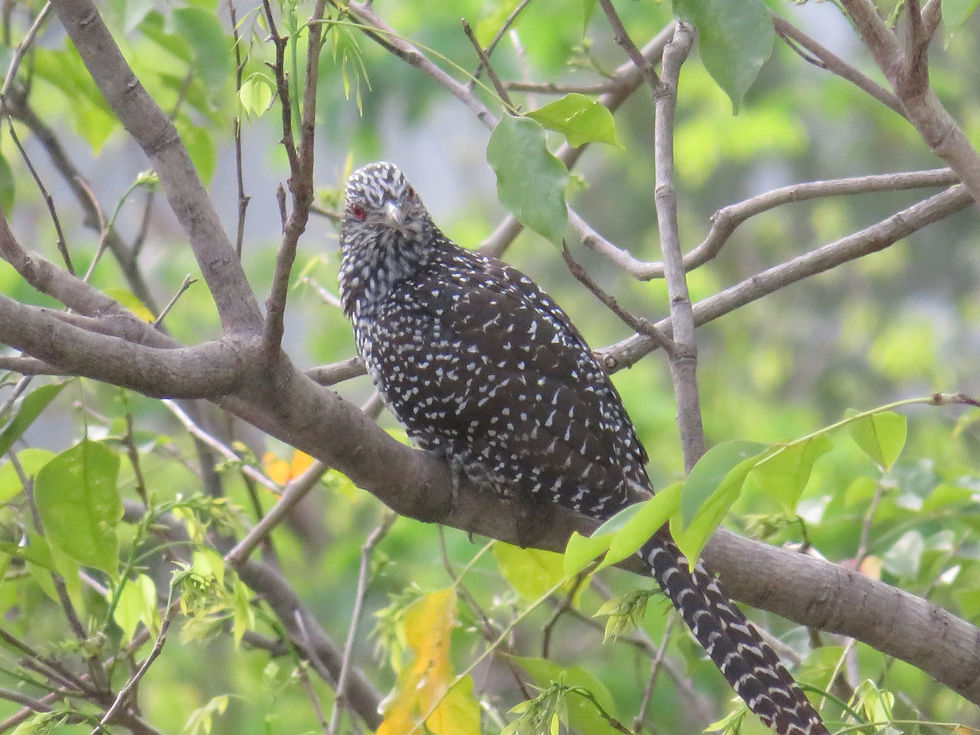
Admittedly, not all the birds present are so welcome- innumerable pigeons are the bane of Sri York's management [and rather cruel attempts at getting rid of them have included non-discriminating entangling nets between courtyard trees], and several Asian Koels, hiding unseen below the canopy, with their repeating and very loud and rising crescendo “uwu-uwu” mating calls ringing across the neighbourhood having woken me up many mornings at dawn, out-competing the minarets via their hours of persistence.
Our trip "home" this time had been particularly arduous. Getting from Canada to Malaysia

is never easy, even for those who, like us, depart from Pacific Vancouver. There are no non-stop flights between the countries, so at least one stop or transfer in an Asian gateway city is required, and possibly another in KL before taking the 1 hour domestic to Penang. If the routing is good, it will total about 17-20 hours in the air, 20-24 hours flying time, and another 3-4 hours door to door. This go around, the best option in terms of both price and time involved taking United's 17 hour non-stop San Francisco to Singapore flight, after a 2 hour early morning flight from YVR to SFO, and a quick transfer (doable because one goes through US customs prior to departure in Vancouver's airport itself). We would then spent a relaxing evening and night at a hotel in Singapore, very close to the 10 km long East Coast Park, overlooking the Straits of Singapore with a flotilla of large ships moored a moderate distance off, and its paved bike/rollerblade path that we had come to know well (with nearby rentals). We would then take an ~80 minute mid-day flight up to Penang after exercising the next day, allowing us to feel fresh on arrival.
For those who don't know the geography, Singapore sits at the southern tip of mainland peninsular Malaysia, an island separated by a walkable bridge over the narrow, winding Straits of Johor, which was indeed how I left Malaysia my first time (entered by boat, left by foot!). They were actually fused into the same country at the birth of "Malaysia" in 1963, soon after independence from the British Empire was granted in the late 1950s (to then Singapore and Borneo territory-less "Malaya"), but two years later split related to its Chinese-majority demographics and sociopolitics conflicting with those of the rest of the Malaysia, which, other than Penang, is heavily Malay / Muslim- dominated. Our first two post-covid trips back (on the pleasant Japanese ANA airline, with transfers though Tokyo's Narita, as close to a midpoint from North America to Southeast Asia as possible) had also involved short stays in Singapore, which had been very enjoyable for us both, a combination of tourism, exercise, and relative-visiting. We were confident that this time would be just as smooth.
We arrived in San Francisco on-time, and it was just a very short walk around the corner to our departure gate, without any need to go through further customs or security screens. Looking good. However, minutes later, they announced a short delay due to a problem with one of the seats in business class, and started asking for a volunteer to switch from business to economy for a $1000. reward. Five minute later, the reward was up to $2000, and they mentioned that the individual would get an entire economy row to themselves.

Soon it was becoming clear that our delay wouldn't be so short. The reward had been transiently upped to $5000, but now they were saying that there also was a problem with the sink in one of the bathrooms. Not a pleasant condition for a 17 hour flight. We would be getting a new plane. No problem, SFO was one of United's hubs, we should be off in under two hours. However the old plane was not leaving the gate, and soon we found out that if things didn't get moving soon, a new crew would also be needed as shift limits were going to be exceeded, although that too was manageable, we were told. Nevertheless, now already a few hours later, the pilot soon came out to tell us the flight was now cancelled altogether. We would all have to go to United's desks to be re-booked on another flight.
Chaos and mass migration ensued. Unhappiness reigned as new lines formed with long waits, while we, and others, simultaneously tried to reach United Customer Service by phone. Mass confusion. Limited seats on the same route leaving that evening, being rapidly taken up by business class passengers given priority service. When, mid-afternoon, we finally got served we were told that the next available flight out on that route was on Thursday (today was Monday). They offered us a route on partner Swissair with a ~six hour transfer through Zurich departing that night. However that would arrive so much later than our original plans that, not only would we miss the night's sleep at the hotel in Singapore, but we would additionally actually miss our next day's flight on the other carrier to Penang. We asked if they could instead route us directly to Penang or even KL (from where we could easily make our own way). No- they would not allow a change to the routing of our purchased ticket, nor help with rebooking our next segment. Extremely frustrated I asked if they could just take us back to Vancouver, then start all over from there again on Thursday. United said they could take us back, however, as we had already flown the yvr-sfo leg of our route, such would mean forfeiting the rest of our trip.
I quickly calculated that accepting their Zurich offer would mean a total ordeal of over 50 hours before making it to Penang. My anger at United, combined with my exhaustion (it was already a very early morning to make the initial flight out), and fear of inability to sleep or deal with my bowels properly (and the previously untested potential consequences of such including obstruction, I can not even try to go on an airplane) for so long had me happy to just say screw you / it to United Airlines and the trip, however I could see that Jiak Chin really wanted to go home regardless, so I acquiesced, and agreed to the ordeal. Therefore, that evening, instead of crossing the Pacific Ocean, we headed east, back across the entire North American continent, and across the Atlantic, a ~13 hour flight to Zurich. Our seats were bad, as was the constant rattling of my seat by the large young man, unaccustomed to flying, struggling in the seat behind me, but at least the chocolates at back were good, so we made sure to stock up in order to create a very minor silver lining to our miserable ordeal. We did get a couple of hours in a room without a private bathroom, in the airport. We both took very nice showers, but the circumstances of the public bathroom was not workable for my issues, and I didn't really get any true sleep either. After another 12 hour or so SwissAir flight (which, thankfully, wisely dipped south of the Ukraine region, despite the flight path showing that we would be crossing the conflict zone- if you think


avoiding it would be a no-brainer then you have forgotten about Malaysian Airlines Flight 17, shot down in error by Russian-backed forces over the Ukraine in 2014, killing all 298 aboard), we landed in Singapore. There, we had a wait of about 4-5 hours (emotionally-shortened by a frustration-induced fight, details long forgotten, but surely I was to blame...), before boarding an easily rebooked AirAsia flight to Penang. After a whopping 53 hours, we had finally made it! Additionally, I had proved to myself that I could survive 53 hours without much sleep, and my bowels sixty-some, though not without significant discomfort. A couple of days later we were over our jetlag and enjoying being back home- surely there would be no further misadventures.
A couple of afternoons later, I was in the bathroom, when Jiak Chin, in the kitchen, began to see smoke through the window, coming from below. The unit's kitchen's slatted window (and attached door) connect out to our small open-air laundry area which, in turn, has a metal grid cage separating it from a central shaft, housing air conditioner units, that runs vertically through the middle of the building, with large open air connections to outside at every floor. We had been hearing a strange, almost industrial -sounding, roaring- type noise going on for maybe fifteen or twenty minutes, but hadn't investigated, assuming it was a neighbour doing some sort of renovation or cleaning work. She came into my room, and although not seeming overly alarmed, as the smoke hadn't appeared that thick, told me that she nevertheless thought we should probably get our passports and go.
A lifetime of false fire alarms do slowly but surely instill a jaded attitude towards such situations. Particularly memorable were the false alarms from a defective system in a new school building into which my private Jewish, but secular studies-focused, Bialik High School moved for my senior year in Montreal. For at least several weeks, if not months, these were occurring essentially daily, at times even more than once in a day. Of course, a school must take each and every one seriously, rapidly evacuating the understandably lackadaisical students, taking roll calls, and awaiting the "all clear" from the fire department before going back inside, and ours was certainly not going to be the exception. One of the quirks of our building and its system was that it was set up in such a way that often the alarm would only be going off in half of the building, allowing activities to continue normally in the other half. One day, one of these alarms occurred when my friend Nelson and I were skipping out on Yiddish class (looking back, I'm not proud of such, however that particular teacher had so little control that there essentially wasn't any teaching going on, with all of the twenty-five or so students holding private conversations in small groups. We all already had acceptances to CEGEPS, Quebec's equivalent of junior college.). However the alarm was in the other half of the building- so there was no need for us to be counted. The gym, on the other hand, was in the evacuated section, leaving it empty! So while outside the gym, its former occupants were being lectured to by our vice-principal for not taking things seriously, inside the gym Nelson and I were shooting baskets!

More recently, both buildings we've lived in in Vancouver have had periodic building-evacuating alarms, to which Jiak Chin and I have responded more cautiously, albeit often slowly in our current building as we are only on the 3rd floor and could exit with the help of tied sheets via our balcony to shrubs below, should it come to that. Fortunately I've never been in a hospital that required evacuations, although my office building did have a minor fire started by a dermatologist upstairs once, putting us all out for a few hours- if I recall correctly I managed to see a few patients across the street in an empty room at the Diabetes Center.
However, this was not a malfunctioning or overly cautious alarm- in fact there hadn't been any-we weren't sure if the complex had a system, and would be hesitant to trust one were it to exist, but instead actual smoke. So I reluctantly, albeit not urgently, got out of the bathroom, got dressed, grabbed my nearby passport and camera, and headed for our door, which is on the other side of our unit, with the kitchen and laundry/shaft in between. I opened the door and was SHOCKED by what I saw- a complete and thick white-out! This was not only the real thing, but serious trouble- potentially deadly serious.
I quickly closed the door, and told Jiak Chin. We were both extremely worried, with the news story and images of London's 2017 Grenfell Tower disaster fresh in our minds. Yet, we maintained control over our emotions and were not in a state of panic, at least not physically. What were our options? Basically should we stay or should we go? If we chose to stay it would mean putting our lives in the hands of Penang's fire department. Although we had no first hand knowledge of their response time, skills, or equipment, this was not a thought that gave us much confidence. Clearly, London's fire department had been woefully, if understandably, unequal to the gargantuan task. It would probably mean waiting for them on our small balcony, ten floors above the complex's parking lot ring road. It may very well be that such would end up being our only option. However it might be a very long wait; it was not clear if they had even been alerted and Penang's traffic near us, especially late afternoon approaching rush hour, could be awful. On the other hand, if we were to consider an attempt at escape, then time was clearly of essence and we would need to get moving very quickly. Our lives were in jeopardy.
Our complex's unit's wooden doors are each set back about ten feet from the floor's central hallway, where there is another metal grill-type door that we always leave unlocked when we are staying at the unit. The elevators (which, obviously, we would not try to use) and main staircase are then about sixty feet to the left, past where our kitchen and bedrooms are. On the other hand there is a secondary staircase that is at most only about another ten feet diagonally to the right of our outer grill door, which I knew well, as I take it down regularly on my way out for ping-pong or jogging. Even in complete white-out conditions, I felt confident I could make my way to the fire door (some floors keep these open with a brick, while others, such as ours, keep them shut as per instructions written on them), and see how things looked in the stairwell, and then make it back to our unit if waiting for the fire department seemed the better option.
JC gave me a wet towel to place over my mouth, and I headed out. Visibility was maybe 1-2 feet, however I knew the area well, and easily made it to the door which I pushed open. Although there was smoke inside the stairwell it seemed less dense than at our unit. I therefore quickly decided escape via the stairwell was worth a try, and went back to our unit to get Jiak Chin. We were not yet ready to consign our fates to passive waiting. Seconds later, filled with adrenaline, we both headed out, through the fire door, and down the first of the ten sets of double stairs, into the unknown.
9th floor- clearly able to see, maybe the smoke was a bit less? 8th floor- the smoke was again more dense, but not unmanageable- let's keep moving! 7th floor- getting lighter again...Good! Keep moving! 6th floor- much better! 5th floor- not much smoke anymore- maybe we are going to make it?
4th floor- not really any smoke at all! 3...2...1...GROUND FLOOR- WE'RE OUT! We hugged and breathed huge sighs of relief. We had survived! Time to spread the alarm and figure out what was going on.
Yet something strange had been nagging at me as we had made our harrowing descent down the smoke-filled stairway- all the other floors, at least from what we could see through those with open doors, or through the very small windows of the others, seemed deserted, nor did we run into anyone else in the staircase. Had everyone else been alerted? Or too fearful to try the stairs? Furthermore there was no crowd, or even anyone else, neither residents nor emergency personnel, near the exit of the staircase. Also no obvious fire, at least not right where we were. We headed in towards the complex's central courtyard and saw a uniformed man wearing some sort of heavy industrial backpack with a tank, holding some sort of large attached hose. But, strangely, he did not look at all like a fireman. I went up to him, said there was a fire, and asked what was happening.

He looked back at me, clearly confused. He was fogging our building in order to kill mosquitoes. When I, in a mixture of relief, confusion and anger, asked why we hadn't been warned, he told me that we should have been, and that notices had been placed by his company on all the elevator doors. Had we just missed seeing it? We checked the elevator- and nothing was posted there. Sure enough, the next afternoon someone knocked on our door to inform us that spraying for mosquitoes would be taking place the following day! No, I replied to him- it had already occurred the previous day, and had caused us to believe we were trapped in a fire! Surprised, he apologized to us. Their company had failed to properly coordinate the project!
Fogging is actually a fairly common procedure used to kill the potentially dengue virus-carrying female Aedes aegypti mosquitoes in many countries during outbreaks, including Malaysia (where dengue is rising, killing over 100 annually), although neither of us had experienced it before. It does not affect eggs or larvae, and therefore is at most a partial control method (eliminating standing water breeding sites being most important), with effectiveness debated. It uses a large noisy machine that blasts a combination of water with a very low concentration of a standard pyrethroid insecticide into very small droplets, creating the fog, and is performed either early morning or early evening, when the crafty mosquitoes (they take small blood meals from up to five people in one feeding, a technique which, unfortunately for us, is ideal for spreading a virus) are most active. Although the insecticide-laden fog is apparently harmless to humans, it is nevertheless advised that residents avoid direct contact with the fog, cover indoor food, eating utensils and children's toys, keep windows closed and stay indoors until the mist has dispersed. Confusingly, other sources advise keeping doors and windows open in order to let the fog in and get any mosquitoes already inside. We did, from a distance, see a couple of other buildings elsewhere on the island undergoing the procedure over the next couple of weeks, and the title photo, reproduced below, is of one of them- looks like a real fire, doesn't it?

Looking back over our scare later that evening, it was clear that there were some aspects of our situation that should have suggested to us that our impression of smoke and fire was wrong. What we saw was indeed a uniform "white-out", not the variable greys of smoke. Moreover, there was no noted associated smell or heat, although we were covering our mouths and noses with wet cloths. Of course, when one's impression is that one is faced with a life threatening emergency, taking immediate action must be given precedence over careful analysis. We thought our lives hung in the balance, and we had responded appropriately. The whole episode had lasted only 2-3 minutes allowing for retrospective humour and easy psychological recovery, but during it, the crisis had been very real to us. We can tell you with no uncertainty: being trapped in a high rise fire is not something you want to experience.
I actually had started to write this piece mid-November 2025, and had finished the condo background portion as I began packing for our trip to El Salvador, when the horrific story of Hong Kong's Wang Fuk Court apartment tower complex fire broke on November 26th. Out of respect for its victims and anyone who may have known them, I put off trying to finish the piece until now, a few months later. That disaster ended up being the deadliest apartment fire in history, killing 168. Only the September 11th terrorist World Trade Center collapse and Sao Paulo's 1974 Joelma Building fire (2312 and 179 deaths respectively) have claimed more among other types of high-rise buildings fires, with the 2017 London Grenfell Tower disaster claiming 72 lives, number twelve on the awful list. Hong Kong's WFC fire is thought to have been sparked by construction workers' cigarette smoking and littering, and then propagated by a combination of corruption-related bamboo scaffolding, safety netting, and styrofoam-related procedural deficiencies. So WTC and WFC tragedies. Again things come down to religion and cigarette smoking, my two Great Hates. Not at all where I thought this piece would end up.
For a positive final spin, maybe it is worth contemplating just how many tall buildings there are in the world, and just how rare these disasters actually are, with false alarms, such as ours, doubtlessly far exceeding real ones. We are now back at Sri York, and last evening I spotted a Racket-tailed Drongo directly from our balcony for the first time!
A very, very special thanks to JW and CW, as always!
Balcony Birdwatching, Penang Feb 2026




Comments