
A Pictured Novella: Selling Our 29 Year Old Volvo and My History In Cars; A Halfcross Canada Drive

Updated: Dec 29, 2025

"We just sold our 1996 Volvo for $1700! We had bought it in 2010 for $2200- so that means we paid only $500 for our car for fourteen and a half years!", my wife boasted in a WhatsApp text to her siblings. Minutes later I was doing the same to my parents. I guess that makes us both cheapskates. In his "Guess How Much" racial financial stereotyping routine, Jimmy Yang states "Asian people love to brag about how little money we spent on something...because the art is in the savings". While I hate stereotyping, this one certainly applies not only to my wife, but to myself as well as many other Asians, and [maybe Jimmy can't say it without getting himself in trouble, but I can] many other Jews as well.
But there is another, more significant, side to the story of why we have had such a cheap old car for so long: we hardly ever drive it. We live in the Yaletown area of downtown Vancouver, with many restaurants and grocery stores nearby, and right off the seawall where we exercise. Like so many of Vancouver's inhabitants, we both moved here as single young adults, far away from our families, and we also opted not to have children. Lastly, it's only a ten minute walk to St Paul's hospital, where we both spent our working careers until our early retirements over the past year. When we bought the Volvo, the odometer read 183 000 km, and now on selling it has just hit 217K km, for a total of 34K km, and an average of only about 2300km per year. Such, in combination with its presence having meant that we went fourteen years without purchasing even a single new car with the accompanying

environmental manufacturing costs of such, has led me to quip on several occasions that our old gas-guzzler is actually greener than our garage-spot neighbour’s Tesla. We have spent about three times as much money on insuring it as on gas, so for us, owning even a cheap car clearly has been a luxury and not a necessity. We took it on a long drive to the dry lands of eastern Washington State the first summer we had it, and several trips to the Okanagan over the years, but otherwise most of its use has been limited to our summer trips to the Discovery Islands, and driving it to our best friends’ place in Vancouver's suburb of Richmond. There were times when it went 4-6 weeks without being used at all between such [or longer if around an overseas vacation], leading us to jokingly refer to it as "The Richmond Shuttle".
Occasionally we'd take it to the North Shore mountains for hiking or snowshoeing, or either Ladner, Delta, or UBC with our bikes on the back, however Vancouver's "war on cars" with the resultant traffic, and ever increasing difficulty getting out of, and back in to, downtown has tempered our interest in local trips. In addition to a steady stream of streets being turned into one-ways, with lanes and parking spaces being swapped out for sparsely used bike lanes [former Mayor Robertson wanted to turn Vancouver into Amsterdam, where there is a throng of bikes waiting at every traffic light, it is not happening, instead traffic and idling have increased noticeably]. Currently [spring 2025], Vancouver's Beach Avenue, where we live, is seemingly the last place on Earth where pandemic rules are still in place, moving the Seawall's iconic and spectacular bike lane to the road in order to allow a third separate lane for pedestrians in the name of social-distancing, turning the major road itself into a one-way forcing everyone, especially if coming back south across the long nightmarishly-designed Lion's Gate Bridge, to go through the core of downtown, before returning to Beach Ave further along. More recently they have eliminated the easy access loops to Granville Bridge, our exit way towards the south, again forcing us to go north into the core of downtown and wait at three crowded red lights, before being able to return the way we came.

I am typing this as the CN Tower comes in view. Presumably we have circled in order to come in with the day's heavy wind. There had earlier been moderate turbulence stopping passenger service, and there ended being moderate swerving on landing at Pearson airport. We have come to Toronto May 3rd, 2025 to take possession of our "new" car, my parents 2010 Infiniti G37X, which we will drive back to Vancouver They offered it to us as a gift given that they hardly ever use their two cars simultaneously anymore. The Infiniti had sat to the point where the battery was dead, and a new one needed to be purchased. My parents had not heeded my suggestion that they disconnect the battery, as we had been successfully doing for many years with our Volvo, after having gotten fed up with recurrent battery problems from rare usage. Our frequent travel-routing through Toronto serves the additional purpose of also seeing my sister and family, in addition to my best friends, all of whom have been part of the Quebecois nationalism-induced Anglo/Jewish exodus from Montreal. When I was a kid, Montreal was actually about Toronto's equal in overall population, and had Canada's largest Jewish population, neither of which are even close to the case today, with all of my high school friends now living elsewhere. Although my ultimate departure from Montreal was never pre-planned, it is instructive to note that when I moved to Vancouver, I had the credentials to practice medicine in 9 provinces and 50 states, with Quebec being the sole exception. Such was due to its requiring a separate exam stream, and my having failed its Internal Medicine oral portion. I was asked about a rare neurological condition, despite neurology being a separate discipline and residency from I.M., it's the only exam I've ever failed!.

We had purchased the Volvo in 2010 after our Toyota Celica, which I had been driving since buying new in 1997, was felt to not be worth repairing by the insurance company [they paid us $7000 for it] after an accident, which I’ll address later. Given how little we drive, we at first decide to try the modern generation downtown thing, and sign up for a car share program. However we soon find that it didn’t suit us, with issues including unfamiliarity, uncertainty over last-minute availability and inconvenience resulting in us not even using it once during our four months of carlessness, even though we were feeling increasingly restricted and trapped downtown. However spending a considerable sum of money on a new car only to drive it a handful of times a year didn’t seem to make sense either [the Celica’s battery had also needed several jumps after non-use its last several years- many taxi drivers will also figuratively “jump” for a chance at one of these calls, generally charging $20 for the few minutes of work].
So buying a used car seemed to be the logical way for us to go, however the process filled me with dread. I just literally wasn’t a used car-type of guy. My parents had always bought their cars new, and such was also standard practice not only in the upper middle class neighbourhood where I grew up, but also among my colleagues and friends. I viewed purchasers of used cars as being the ripped-off butts of used-car salesmen jokes, and spending many thousands on a buyer-beware lemon was the last thing I wanted. I figured that I would probably only keep the used car for a few years before purchasing a new one, and therefore reasoned that it made more sense to buy a relatively older very cheap one for that time period.

We visited a couple of used car dealerships [by bike], but nothing came even close. Next we decided to try Craigslist, which we found very well structured by both price range and vehicle location, but at first couldn’t find the right quality for cost. Our friend, Phil, on giving us a lift to try, unsuccessfully, look at one in the suburbs, commented that in Vancouver, in order to buy a car, one really needs to have a car. Then we saw our future sunroofed, leather-seated, top-of-the-line dark blue 1996 Volvo 960 listed downtown for what seemed the unbelievably good price of $2200. Jodie was a very personable nurse in her late 50s who was now having a rough ride in life, divorced, and now suffering from an advanced head & neck cancer [which I think she later succumbed to, as, after staying in touch for a little while, she failed to respond to a friendly email the next year]. She wanted to get rid of the car quickly with all that was going on in her life. She let us take it for a test drive without her [she stated that we were free to steal it- such would only make things easier for her!], and we loved it. Right away we decided that we would not try to bargain at all, but would just take the car for an inspection at a garage to make sure everything was fine with it, which they confirmed. The only hick-up was, when we went to the Autoplan agent to get the paperwork done, they informed me [erroneously] that due to my accident with the Celica, my insurance costs would be going up considerably despite my prior clean record, so we decided to have Jiak Chin officially purchase the car and be, at least on paper, its primary driver. A few weeks later, I found out that my ICBC “RoadStar” status was in fact unchanged from a single “at fault” accident, due to the combination of a decade of accident-free BC driving with a prior decade of driving elsewhere. I decided to call Jodie to tell her of such, so that she would be confident that her former car was in good hands. She responded “I always knew you were a roadstar”!

After a few days of visiting, our first stop is off Lake Huron’s huge Georgian Bay, sharing an Airbnb rental with my parents on Byng Inlet, where a kayak allows me to reach the mouth of the bay and circle around one of its thirty thousand islands. We then part ways, with my parents heading back to Toronto, while we continue north and west around Lake Huron to Sault Ste Marie, and the Group of Seven Canadian landscape painter-derived famed Northern Ontario, our principal destination for the drive. Actually what is commonly referred to as “Northern” Ontario is really, by map, the western part of the province-which happens to be further north than the much, much more populous east-located “southern” Ontario [which has 12% of the land, but 94% of the population]. Furthermore those using the term usually are just talking about the southern part of the west, with its more northerly section even more sparsely populated and not reachable by road. Along the way, I am surprised to see a very large ‘THIS IS INDIAN LAND” [as opposed to terminology now generally viewed as being more currently appropriate] graffitied in bold yellow taking up the entire span of a rail bridge paralleling the highway. Despite its rough edge, Sault Ste Marie has plenty to see including its locks on St Mary's river, which connects Lakes Superior to Huron downstream, Whitefish Island [where a set of beaver dams serve the same purpose amid walking paths


and swamps, where JC spots a muskrat just below our walkway!], the world's last emergency swing dam bridge [used only once, in 1909, successfully], the SSM International bridge [the only crossing point within 1000km, other than swimming], as well as interesting museums and murals. We also briefly visit nearby St Joseph's Island, where we are given a private tour of Adcock’s Woodland Gardens by brothers Grant and Dennis of their partly cultivated, flower and pond with snapping turtles-filled grounds, as it is a week before their planned opening. St Joseph’s is among the world's largest lake islands [also called nested or recursive islands, especially when they themselves have smaller lakes, some, in turn, even having their own islands!] , although it is dwarfed by its eastern neighbour, Manitoulin, which ranks #1. But when it comes to size and superlatives, Superior awaits.
We had ended up keeping the Volvo much longer than either of us expected. With our “NiHao HaiBao”-monikered kayak a-top, 1985 Thule rack-carried bikes behind, and plenty of room for groceries on the back seats for our trips to Quadra and other local islands, it continued to serve our otherwise limited purposes very well. Adding to its character, It did, however, develop quite a number of quirks over the years from unfixed minor problems.
In the summer of 2014, while waiting in line for the ferry to Denman Island, the attendant comes up to us and states that she had smelled fuel when we purchased our ticket at the booth. Indeed, on looking underneath, there was a large gas leak- the car would not be allowed on to the ferry. Oh No!! With a car fully-packed with clothes and a week’s worth of groceries, and our bikes as well, what should we do? Furthermore, the cabin we had rented


was very far from the ferry terminal landing, and the island was unlikely to have any public transport.
First things first. We arranged for the Volvo to be towed to the Canadian Tire in nearby Courtney. We decided our only option for saving the trip would be to try asking other drivers in the line-up for assistance. I first target a middle-aged lady who appeared to be by herself in an SUV, rationalizing that there was some hope of getting our bags, and maybe even bicycles taken. Success!! Barbara saves us! Not only was she willing to drive us and our stuff to the cabin, but she also actually had a bike rack in her car, and could easily take our bikes as well! Furthermore, she had another trip planned into Courtney in a couple of days, and offered to bring us to the Canadian Tire then in order to pick up our car. They end up giving us a rental for the rest of the week, needing more time with the Volvo.
We drove back to Courtney at the end of the week to pick up the Volvo with a new gas tank in place, however the saga was far from over. Now our dashboard gas meter reads as being on empty, only minutes after filling up! However, on looking beneath the car, this time there didn’t seem any leak. After being reassured by the Courtney branch that it was safe to drive home, we brought it in to a Vancouver branch to get the gauge fixed. The saga continued to domino when the technician there told me that there also was a problem with a compromised fuel supply line that he felt certain would not last long, a repair job that would require a lot of labour time. Furthermore, he could only locate a single such replacement part in all of North America- currently sitting way down south in Alabama. Having just spent close to $1000 on a car with an uncertain medium-term future, we opted to buy the $80 part, but hold off on the expensive replacement until absolutely necessary. A few weeks later, after a bit of driving, I became increasingly surprised to see the gas gauge now still reading as completely full. I kept a close eye on it on our next few short drives, but it still didn’t budge downwards at all. Soon it became obvious that the gauge, which was previously stuck on empty, was now stuck on full. Frustrated with the never-ending problems and repeated visits to Canadian Tire, we decided to instead fill up and just track our distance driven using the trip odometer, resetting it at each, always complete, filling, and planning to never go beyond 400km before the next fill.
And so things remained for the next decade, without incident. Although we were always a little nervous driving over gravel roads, the supply line replacement part has sat unused in a small plastic bag in our trunk, and our system of tracking remaining gas in the tank has worked as planned. “If it ain’t broke, don’t fix it”, a maxim to which I generally ascribe, at least for non-cardiovascular matters.

The Volvo has developed other issues over time, but nothing major. Brakes were replaced. At some point the shift lock got stuck, and for many years shifting out of park has required two hands- the second to depress the shift lock button which must be simultaneously done each time. A sunroof leak was largely eliminated by clearing its gutter. The air conditioning has stopped working, but only rarely is the temperature bothersome. Power-steering and engine oil leaks have been largely resolved by the amazing Lucas Stop Leak products- they actually work(!), and saved us from needing expensive repairs. Very rare usage eventually led to needing a new battery despite disconnecting it, but things have again gone smoothly since learning how to disconnect the slightly more complicated terminal of the new battery after its initial discharge. Some maintenance was done, but not much, given that at each point I was expecting to not keep the car much longer.
Most recently, after plans were made to get my parents car, but with one last Quadra trip with its crucial need for the Volvo remaining, the car started to shake violently whenever in park or at a stop, but not while actually driving. Fortunately all that was needed was to replace a single malfunctioning spark plug/ coil that was putting the engine off-balance. I am pleasantly surprised when the mechanic, Adomas, calls our Volvo “a sweet ride” and mentions some interest in it for after our trip. He later states that about $1500 would be a fair price, but by then he has purchased another. Never did I need to put more than $1000 into the car during a single year, and there were many years when I didn’t put any money into it at all.

However, maybe the Volvo’s best story of all is how a tire blow-out in 2020 led through a series of strange circumstances to Jiak Chin’s becoming acquainted with a member of her old Malaysia- Newfoundland circle of friends. The incident occurs suddenly and without warning, but only at a velocity of 50-something km/h, allowing for my easily regaining control of the car on the quiet country road. Initially, it leads only to a missed Cortes to Quadra ferry. After help changing the tire, we catch one later in the afternoon, and order a new set of tires to be put on in Quadra. It was while waiting for those new tires to be put on that circumstances start to painfully converge on me.
So many components- where should I begin? Maybe back in the late summer of 1991, when I was a medical student at McGill doing an Emergency Room rotation at the Jewish General Hospital. I had the sunny weekend afternoon off, and was biking around the quiet streets of my home suburb of Hampstead, when I suddenly felt a sharp sensation on the upper back of my shoulder. Thinking it must be a sweaty hair being pulled by my shirt, I continue on. But seconds later another one on my stomach. I stopped and, on touching the area, found a stinger, but the insect was gone. Brushing the incident off, about a half hour later I was taking the sun in our back yard when I began to feel strangely itchy. Going inside and looking in the mirror my chest and neck were both abnormally red with some swelling, but no trouble breathing. I had been stung before, but never had any sort of systemic reaction, nor significant swelling. So I had my Mom drive me into the ER at JGH, my Dad coming downstairs from work to join us, where after convincing my attending that this was indeed a systemic reaction and not just a tan, I was given epinephrine and steroids for a minor anaphylactic reaction. As chance would have it, at that very same moment, less than a year after coming to Canada as a very young Malaysian girl abroad for the first time, and deciding that she didn’t like Toronto, flying directly overhead on her way to start her Dietetics Program at Memorial University in Newfoundland [the only province I am yet to visit- but yes, I married a Newfie] was, Jiak Chin. Ok, so maybe that part most likely isn’t completely accurate time-wise, however I am taking a bit of writer’s poetic license here, and as far as I can reconstruct the two events did occur within the same month or so, and the above is not impossible- on telling such to Jiak Chin, she replies “so you finally figured it out?”.
Regardless, on further testing by an allergist, I reacted minimally to the highest concentration of wasp venom, and he told me, that most likely my episode was due to the multiple stings and that I would probably not have a severe reaction if stung in the future, but that he couldn’t promise such, and advised that I always carry an epipen. So from that time on I started to keep one in my hiking bag, another in my bike seat pack, and a third in the car, so as to not have to always go looking for one each time I head out [often at least one would be expired, but a study years later showed them to be effective up to five years beyond expiry- don’t take my word for this- keep yours up to date!].

Nice story- but what’s that got to do with your Volvo and JC’s Memorial friend? I’m getting there. One more piece of background first: biking outside Victoria summer 2017, we come across a Lonely Planet Malay phrasebook for $2 at a garage sale. Having easily learned a few words of the near-identical Indonesian years earlier, I decide to purchase it, planning to give it a week of study prior to our next trip back to Malaysia the upcoming winter. I am amazed to be able to state that, after the week of study, my Malay, with its straight-forward pronunciation and lack of tones, is nearly as good as my Mandarin is after four years of study.
Now back to the primary story, in the COVID-haunted summer of 2020. While waiting for our new tires to be put on, I go for a wander while Jiak Chin goes to the grocery store. Soon I need to take a leak and ask to use the washroom at the Cove Pharmacy. However they refuse to allow me to do so, with it being now reserved for employees only due to COVID protocols. The one at the grocery store is occupied, and preferring not be inside that crowded store, I decide it can wait. Soon, I am off wandering on the nearby wooded Green Avenue, and see a small trail into the woods, so I decide to answer nature’s call there. While doing so I feel a mosquito bite on my leg- a strangely painful one…then another! There is no way those were mosquitoes, I must have stepped or urinated on a wasp’s nest…another! I start flailing my arms and run out of there, pants still partially undone! I run for a full block before slowing down. Calming down, something prompts me to remove my baseball cap, and a second later I get another sting on the back of my neck. That last damned wasp had apparently sat on my hat throughout my over a minute of fleeing, waiting to strike. Maybe 5 or 6 bites in total. I have been stung in the interim without reacting, but never more than once at a time. This could be trouble.
I find JC and tell her what has happened. The epipen is back in the car at the garage and expired. Quadra does not have a hospital, and the daytime-only clinic in the same small strip mall as the pharmacy closed minutes ago, at 4pm. We knock on the door and a nurse answers and lets us in. The physician is already gone for the day, but the nurses tell me they have at least another half-hour of paperwork to do before leaving. Although, minutes after the attack, I am still fine at the moment, we all know it may be too soon to see anything. We decide that I will prescribe myself a new epipen [and, in the end, also some prednisone. Self-prescription is generally frowned upon, but emergency medications are easy to justify] and pick it up now at the pharmacy, where I mention that, ironically, had they let me use the washroom none of this would have ever happened. We pick up our car, and then return to the clinic.

By the time I get back to the clinic, maybe thirty minutes after the attack, the swelling around the bites on both legs and my neck has increased and hardened, and I am beginning to develop red blotches on my stomach, where no bites occurred, with the rest of my stomach turning pale. This is clearly a sign that the reaction is systemic, although again nothing serious as yet. So what to do? Using the epipen is an option, however the clinic does not have a defibrillator, and although potentially life-saving, epinephrine can also rarely cause a potentially fatal arrhythmia, and therefore should not be used lightly. As there is no compromise to my airway or breathing, I’m not ready to chance it outside of a hospital setting. However not only is the clinic closed, but the island’s ambulance shift is ending shortly as well, with the only option later in the evening for emergent care being via helicopter, after the ferries are done for the night. In other words if we are to activate emergency services in order to take me to the hospital in Campbell River, then it must be done now. We decide to play it safe, and the nurses make the call. Minutes later the ambulance arrives, with the EMS techs in full COVID gear. We just miss the 6pm ferry for the short crossing. The next is at 7pm, and neither the EMT nor myself feel the situation is emergent enough to call them back, so we decide to wait, sitting in the ambulance.
My vitals are stable, and, if anything, the mottling on my stomach is looking less prominent. We start to talk about other things. The tech looks Southeast Asian to me, and, feeling proud of my Malay linguistic skills, decide to try it on him. Sure enough, he speaks the language, and tells me he is indeed also Malaysian, from Kuala Lumpur. The conversation pivots to Jiak Chin, who is currently sitting by herself in the Volvo, behind us in the ferry line-up. When I tell him that she went to Memorial, his face lights up- he went there too!! Roshan, now living on Vancouver Island, is only a few years older than JC, and the Malaysian contingent at Memorial is a fairly small and tight-knit group. We get out and tell her of the connection. Although neither are sure if they met, they indeed have friends in common, with whom they are in touch! And so, the combination of a flat tire on an old car, COVID protocols, my wasp semi-allergy and linguistic curiosities, a university on the far side of Canada, and Quadra’s limited medical services has led to two Malaysians closing a circle on a sparsely populated island on the far side of the Pacific!
We have remained friends with Roshan, and usually meet up with him when we are on Quadra. I ended up sitting stable in the ER waiting room of Campbell River Hospital, where I am thrilled to see on the television my Montreal Canadiens were playing playoff hockey in August in a very unusual COVID- delayed and altered format. Still sitting, now for over an hour when the game ended [a rare playoff win], I had improved to the point where epinephrine was clearly no longer needed, and the last ferry back to our place on Quadra, at around 9pm, was fast approaching. I speak to the head nurse, and with his unofficial agreement, sign a leaving against medical advice form, rather than await the physician and miss the boat home.

Speaking of large boats, the legend lives on from The Chippewa on down, of the big lake they called Gitche Gumee. More commonly it is known as Lake Superior, where we will spend the next few days. Generally it is viewed as the world’s largest lake, with Huron and Michigan considered as separate [true culturally, but hydrologically they are connected without consistent flow or elevation change], and the much, much larger Caspian as a sea [partly for historical reasons, but backed up by its high salinity, and the fact that it is a remnant of the ancient Tethys Ocean and thereby centered on an oceanic basin rather than lying entirely over continental crust as all other lakes do]. We head north from Sault Ste Marie continuing on Highway 17. After a short stop

just beyond the city limits at the spectacular, roaring, spring melt-swollen Crystal Falls, we soon unexpectedly cross the highway bridge of also-roaring Chippewa Falls. Shocked and impressed, I rapidly pull to the side and U-turn. I park at a trading post where the Toronto Maple Leafs t-shirt wearing owner informs us that we are at the midpoint of the TransCanada highway, completed in 1962, about 3400km from both Victoria, BC and St John's, Newfoundland. He agrees to a photo holding out two commemorative wine glasses laterally [I tell him that it will be good luck if he thinks of them as Stanley Cups, with the Leafs currently leading their 2nd round series 2-0 over Florida].
Back on the highway, we soon pass the closest point to where the Edmund Fitzgerald split up and sank in 1975, forever memorialized and popularized by Gordon Lightfoot's haunting ballad, with its opening line also opening this paragraph. I run barefoot on Harmony Bay beach, and then the even better, powder-sanded Pancake Bay Provincial Park beach. We had been worried about alternately mosquitoes and then snow, but as the sun beats down heating the sand below my feet on the nearly deserted beaches, it seems that we have timed the trip just right. A park ranger later tells us the black flies should arrive next week, followed by the mosquitoes 1-2 weeks later. More roaring waterfalls at Lake Superior PP's Sand River [and

over the next couple of days also at Silver, High, and Aguasabon Falls- spring is clearly the season for waterfall viewing] , before pulling into the well-appointed High Falls Motel and Cabins, run by a friendly Polish couple. We donate some old clothes of mine, including a leather winter jacket worn as a medical student, at a thrift store in nearby Wawa [I decide

not to make an issue over the shop’s heavy marijuana stench], purchasing a couple old rock CDs for the Infiniti, while the appreciative store clerk serenades me with “Mammas Don't Let Your Babies Grow Up to be Cowboys", proving me wrong after I tell her I don't know who Waylon Jennings is.
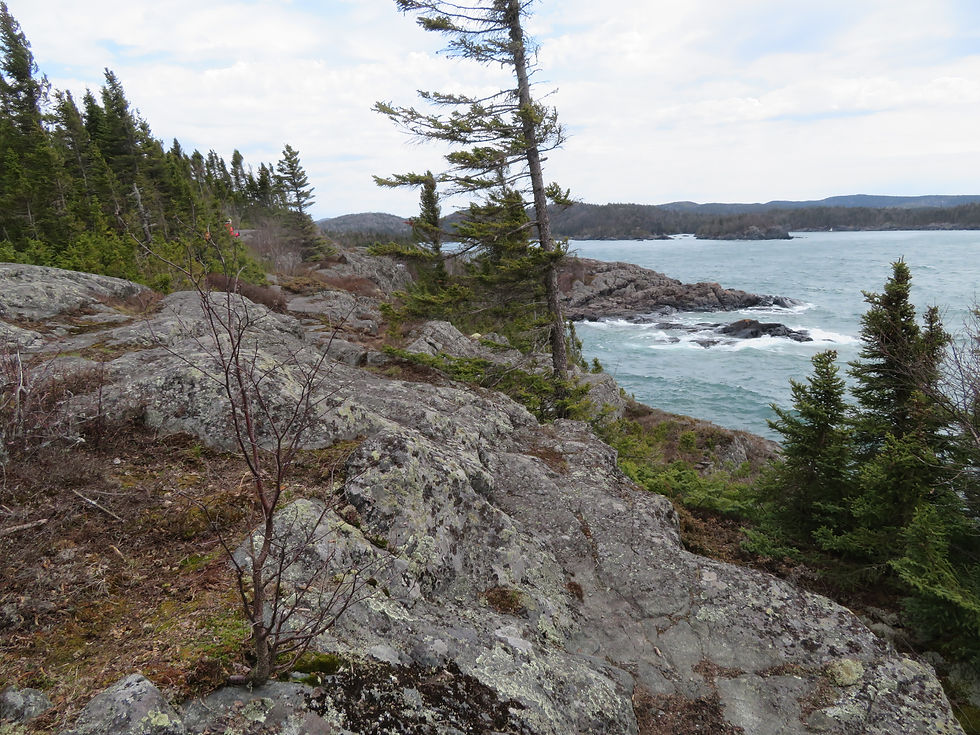
Pukaskwa National Park [pronounced Puka-saw] is the only national park in the Lake Superior region, and we quickly come to view it as a cut above its provincial park neighbours. Orange lichens on glacier-smoothed rocks contrast green slate mosses hanging off a mix of birch and pine trees backed by whitecaps over waters ranging from turquoise to dark blue and black with wind-swept beaches and distant sand dunes make for a spectacular kaleidoscope of colours, exploding whenever the sun manages to peek through the fast-moving clouds and intermittent rain. A cold, bracing wind with gusts of up to 50 km/h leads me to muse that it is only fitting that we should have one day of harsh weather at Superior- the forecast for the next two is for unseasonable warmth and sunshine.

The mossy ground around one tree's roots begins to move like a miniature earthquake, repeatedly opening up a small chasm as the tree creaks from the breeze. Making sure we are out of the possible fall path, we watch in fascination for a few minutes, however its time is not up just yet. I imagine the words necessary to do the hike's scenes justice. The horizon at Lake Superior seems endless, just like at the ocean. Yet I know that in both cases this impression is illusory- one can only see a maximum of 5 km at sea level, although this rises to 20 km at a height of 100 feet. The welcoming local entrepreneur, Chris, at The Hungry Moose Restaurant and Motel outside Schreiber offers to make JC off-menu egg foo young with her pan-crusted shrimp, opposite my full rack of ribs, which I tell him I am naming "two-province ribs", as that is how long it will take me to finish the oversized portion. He tells us how, in addition to real-estate, he diversified into groceries, which still make up a majority of his sales, during the pandemic, as well as taking a chance early on at supplying masks, including to a local factory.
Back in April, having finally returned home to Vancouver after two months in Penang and two weeks on Quadra, it was time to sell the Volvo in order to open our single condo parking stall for the Infiniti. A very helpful used car dealer tells me that he can’t take it, but suggests we list it on Facebook Marketplace for no less than $4000., after finding comparables for $3.5K and $9K while on the phone with me. Scrap yards tell me that the best they could offer would be only $300. We decide to list for $3000 on both FM and Craigslist. We include a full list of the Volvo’s “idiosyncrasies”, as we want our buyer to be fully informed about it, and happy with their purchase. With only two weeks before our flight to Toronto, and limited interest received, we rapidly drop the price to $2400, and then $1800, now starting to get some queries [mostly on FM], but no follow through, with one random guy not showing up for a look that he had requested [he did later respond that there was a problem with his car that needed urgent attention, but never contacted us again].

After lowering the price to $1700, a couple more individuals contact us, including Raj Gill from Surrey, who Jiak Chin feels seems reliable, arranging a time for a look and test drive. She decides to give the car its first wash [other than rain] in probably a decade.
Raj, an 18yo recent graduate now working his first job with a utilities-related company, shows up right on time, driven by his Mom, who waits in her car parked around the corner under the Granville Bridge. They need a 2nd car, which will officially go under her name, as he has been using hers for his daily 50km round-trip commute. He seems quite interested. We walk around the car reviewing its quirks. He looks under the hood, and I show him the fuel supply line replacement part sitting in the trunk, which I tell him we will include at no additional cost. He tells me that he has done three years of automotive classes, and looks forward to putting some work into the car. Calculating that, if all goes according to plan, he will take about two years to drive it as far as we have in the last fourteen, I tell him that such is good, and that it will undoubtedly need some tender loving care.
He asks to take it for a test drive. I forget to ask him to show me his driver’s license, which is the only real precaution we need to take, remembering only after we’re done. Although we are only going a few blocks around Yaletown, I tell him that he can try out the accelerator. I am briefly stunned when he guns it and I am pushed back into my seat! Fortunately he only keeps this up for a second, satisfied with the car’s intact capabilities. Getting back to our place, he tells me that he likes it a lot, and is agreeable to our price, but has another appointment scheduled to see a BMW in Abbotsford for $1200 later in the afternoon. He states that he will decide between the two cars and would like to make his purchase today, promising to let us know either way.
Thinking that we don’t stand much chance against a BMW at a lower price, JC and I find our competitor’s listing on the net. It has a very ugly hood, with considerable superficial damage- maybe we haven’t lost yet. Sure enough, about two hours later, Raj messages us, stating that he wants to buy our car! He later tells me that the BMW also had concerning problems when he drove it, making strange noises on turning the wheels.
The internet is full of warnings for potential car sellers about what sort of payments to accept in order to not get scammed. Raj tells us that he couldn’t get enough cash at the ATM, but is happy to send JC an e-transfer, which we accept, but state we need to await seeing the funds in her account before signing things. In British Columbia, all used car transactions have to go through an ICBC Autoplan broker, so the four of us walk to one a few blocks from our place, while their car sits in our visitor’s parking, given the unlikelihood a finding a spot closer to the downtown broker. Raj and I walk on ahead, while JC talks with his Mom walking more slowly behind us.
We talk about Vancouver’s war-on-cars, and how all the parking spots have been removed for bike lanes, among other topics. He seems like a nice kid, but one who is clearly susceptible to the stereotypical attitudes and dangers and of teenage male life. Barely a sentence goes by with use of the adjective “fuckin’”. He tells me that he once got pulled over for going 160km/h with an illegal lane change and “apparently” tailgating. He justifies his driving by commenting that it was on entering the highway from a ramp, and “you never know when someone will be coming at 200km/h”. Somewhat shocked at both such driving and his candidness regarding it, I decide it best to act my age and suppress my urge to respond by telling him of my own speeding exploits from my youth. I am also confused on how he could afford the ticket, however on asking him how much it cost, he responds that the policeman let him off with just a warning! I advise him to drive cautiously, suggesting never more than 10-20km/h above the limit, to which he counters “they won’t look at you until you are 30 over in Surrey”.

At the broker, now over 30 minutes since the e-transfer was apparently sent, JC is still yet to see the funds in her account. It is a Sunday, and the agent comments that he has had times where the clients have waited uncomfortably for hours, or even had to come back the next day. However, minutes later the funds arrive in her account. We continue filling out the forms. Our car is too old to have a set value in their system, so they accept our sale price for calculating the taxes that they are owed. Raj and his Mom seem to be unaware that they would have to pay such, with Raj retorting “fuckin’ taxes!”, to which I correct him “friggin’ taxes!”.
Paperwork done, I hand him the key, and we walk back to our condo. I tell him that, even though it is his now, there still is no smoking allowed in the car! He tells me he never smokes tobacco, but occasionally marijuana, so I warn him about the dangers of such and driving. Hopefully he will listen. He is again very heavy on the gas pedal followed by quick braking when he takes the Volvo out of its parking stall. After another second of shock and concern that he may hit the support pillar beside our spot, I am relieved when he makes it safely out of the garage, our responsibilities over! Outside, the four of us take a photo next to the Volvo, we congratulate him, and wish them warm good-byes before heading back inside. A few minutes later we text him a reminder that he will need to fill up with gas shortly after getting back to Surrey. Hopefully he will do well with it and take some of my advice.
A month later, on bringing the Infiniti in to our mechanic for the provincially-mandated car importation inspection, I am surprised when the mechanic mentions that Raj had called him, and asked if he had worked on the Volvo, and planned to bring it in for some work. How did he know where we got it serviced?? I was quite certain that I didn’t tell him, and we didn’t give him any of the repair invoices. Nevertheless, Adomas, also confused as to how Raj made the connection, reassuringly tells me that he seemed happy with it. Later that afternoon it strikes me- there was an oil change reminder sticker on the windshield!

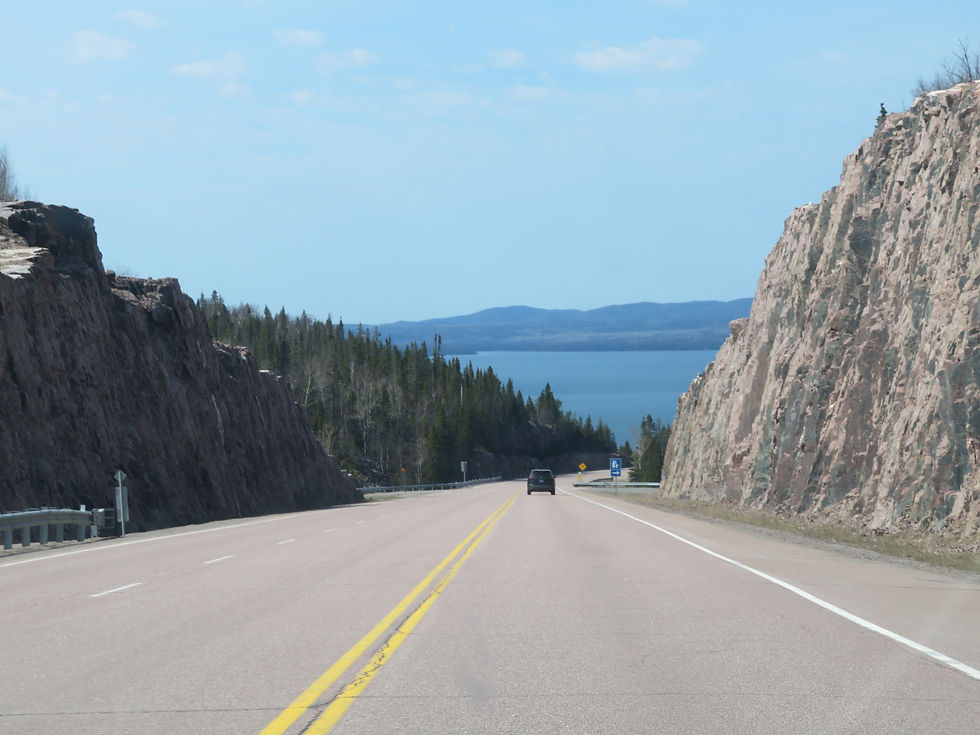
Thunder Bay, our next stop, is a name that doubtlessly sparks the imagination of every kid growing up Canadian, although few probably ever get there. Maybe that's for the best, as, unfortunately, the reality falls well short. The city [unlike the bay after which it is named] only came into existence in 1970, when the competing port towns of Fort Williams and Port Arthur merged. This makes for an unusual layout with two downtown districts with strip malls in between. Walking through Fort Williams brought Steppenwolf's lyrics from "the Pusher Man" to mind: "I've seen a lot of people walkin' 'round with tombstones in their eyes." Port Arthur was only slightly better with cannabis stores seeming to be the only things open on a sunny Wednesday afternoon. On the other hand, the drive in was much nicer: a highway often paved in shades of pink, lined by colourful cuts through the corresponding granite rolling hills with spectacular views of the Great Lake.

Just before getting in, I feel a tear welling up as we make the compulsory stop at the evocative Terry Fox monument. Moments earlier, the corner of my eye had caught sight of the 3339km milepost marker where he was forced to stop his one-legged cross-country run in 1980 due to recurrence of the osteosarcoma that had three years earlier resulted in an above-the-knee amputation of his right leg.

Earlier in the day, I had run the closed 3km access road up to the impressive jagged-walled, glacier-cracked, wind, rain and ice- expanded, Ouimet Canyon PP gorge. “Closed" provincial parks have been a recurrent issue, with most only officially opening mid-May, however daytime access when closed varies without publicity from welcoming with staff consent and visitors expected, to closed off and inaccessible. We also visited the peninsular Sleeping Giant PP, with its thin iconic Sea Lion sea arch.

There, I know that it is now or never for a dip into Lake Superior's frigid waters. I tepidly wade in barefoot over the shallow, slippery rocks, and then, with my customary shout of 'Haleakala!", plunge in for 3 underwater strokes before rising with fists raised in victory! The next day we visit the third great nearby natural attraction, Kakabeka Falls. Considered the "Niagara of the North" it is certainly the best of the falls we've seen so far, possibly even surpassing its famous counterpart for setting and viewing accessibility.

We head out of Thunder Bay on Highway 17. Here, as through much of the country, the Trans-Canada actually has two alternate routes, the other being highway 11 through most of Ontario. The scenery here is a significant notch down from Superior's north shore. Ontario is so wide that it actually has two time zones, a fact that we only became aware of when mentioned by our Airbnb host. About an hour west of TB, we pass a plaque stating that we have now entered the Central Time Zone, Jiak Chin's iPhone has already updated itself. Minutes later we see a man running behind a cart on the side of the highway. Given that my friend / anti-tobacco colleague, Errol Povah had run cross-country in 2010 in his "Journey for a Tobacco-Free World", I am compelled to stop and find out more.

"The Fellow in Yellow", Trevor Redmond, almost lost his leg in a car accident when he was 15, spending a month and a half in hospital, and needing close to a dozen surgeries. He is now in his 50s and doing his 3rd there-and-back cross-country expedition for "health, mobility and recovery", a run, after a walk in 2007, and bike ride in 2009. We ask him to contact us when he gets near Vancouver, and give a small donation. With close to six hours of driving, this day is our first long drive, with little of interest beyond the mediocre "Sandbar" PP [it only has a regular beach] before the Lake of The Woods region near the Manitoba border, where we will stay in Kenora, its principal gateway town [previously called Rat Portage, referring to the area's abundant muskrats].

Although our 1996 Volvo 960 was special, when I think about “My Car” it will always be my 1997 manual blue slate metallic Toyota Celica, which I bought new from a dealer in Newport, Rhode Island for $19000 USD. I chose to wait for the added character of that more unusual colour [and for a sunroof to be installed], with none of the more easily available standard black, by then more boring white, or the flashy red choices speaking to me. At the moment, it seems distinctly possible that it will be the only car I ever purchase new in my life, unless an unforeseen future move away from Vancouver is in the cards. I will always recall the first words of my Brown University Endocrine Fellowship mentor, Dr. James Hennessey, on seeing it: “It looks like a Porsche!” Did I love it? It certainly had the curves of a beautiful woman [I remember sarcastically thinking to myself that I had traded in a beautiful woman for a beautiful car, given the recent end of my first serious relationship], and I can still recall the specific details of, and my emotional reaction to, the first little scratch and dent that it got. I had many great driving adventures with it, starting with the scenic and winding Skyline Drive through the Blue Ridge Mountains of Shenandoah National Park.

The next year, after my fellowship training finished, I import the Celica into Canada, which required modifying the car so that its headlights would be always on, and ironically for me, putting in an attachment to potentially connect to a child’s car seat. Coincidentally while stopped at the border, I run into the very same long-time friend who had given me the lift down from Providence to Newport to take possession of the Celica, Brian, who is also returning to Canada after having finished his neurology subspecialty fellowship also at Brown. We have been unintentionally following each other around for many years, also going to high school, Cegep [Quebec’s unique 2-year bridge between high school and university], and medical school together, and by chance had our residencies only an hour apart at UConn and UMass. In 1999 I drive it eastward to the Maritimes, where I do a 3-month locum in Moncton, and spend my weekends touring around the rest of New Brunswick, Nova Scotia including the beautiful Cape Breton and Cabot Trail, and Prince Edward Island. This means, that the following year, when I drive it out to Vancouver in order to start work, the Celica functionally completes a full cross Canada drive [for sticklers, it does later get to the west coast of Vancouver Island, but never to Newfoundland]. My then functional girlfriend, Shari, joins me for the trip, with our first stop being a visit with Brian, who, again coincidentally, happens to be Shari’s cousin. He now is living in London, Ontario, and has a newborn baby girl. We continue through the, then less controversial, Ambassador Bridge between Windsor and Detroit, and make a stop in Madison, Wisconsin, before heading back north through North Dakota to Winnipeg, and the TransCanada.

My main memory of Winnipeg is of watching a giant mosquito chasing us in the rear view mirror as we speed away, after having been mauled while trying to relax in its Central Park. We also visit a friend in Saskatoon, sampling the berries and getting lost in a large maze, and take a couple of extra days in the Rockies, going on the Columbia Icefields tour, before completing our 10-day drive. Shari flies home, but we remain friends decades later.
However the girl who gets top billing when I think of The Celica will always be my future wife. It is May 2002, very early in our relationship, and we have planned a weekend trip to BC’s interior, the sun-drenched, fruit orchard, and vineyard-laden Okanagan Valley, where neither of us have been before The drive is a bit over four hours, and heading out after work, we plan on eating dinner in Hope, then going over BC’s infamous Coquihalla Highway, with its summit at an elevation of 1244m, and stopping in Merritt for the night, making it a short drive to our destination of Kelowna the next morning. Being from the east, where it is available at most highway exits, I hadn’t really paid much attention to gas, knowing I had close to a quarter tank left. Soon something makes us realize that we may be in trouble- possibly some sort of check your gas sign. If there had been a clear “last gas for “X” km sign earlier, then we would have taken heed, however there was nothing so specific. Now, turning back would be quite a hassle, and knowing there is a toll mid-way at the summit, feel there must be either a gas station or some other way to at least get enough to get us through up there. The near-constant uphill slope for 55km has the tank on empty, and warning light on, by the time we reach the tollbooth [the toll was later removed in 2008, and in 2014 the speed limit actually increased from 110 to 120km/h despite the road’s dangers]. However there really is nothing at all there other than the booths.

The attendant confirms our fears, telling us there is no fuel at all to be had up there, nor anything along the many exits before the city of Merritt, 60km away. The best he can do is provide a phone booth to call a tow truck. I make the call, but there are none any closer than Merritt itself. Rescue, in addition to cost, is going to take well over an hour, and it is late, and we are both tired. I have never run out of gas before, although I’ve never been so low with so far to go. We decide to chance it- at least we will be closer when we get stranded. We head off. I drive at 88 km/h in order to maximize fuel efficiency. Soon there is a downhill slope starting- and a pretty good grade at that- I decide to put the Celica into neutral. We keep up speed, and actually soon start to accelerate in neutral! After a bit of coasting, we start to slow, and I need to put it back in gear. However only minutes later, another steep downhill! Back in neutral we are now accelerating up to even 130 km/h at times! We are over halfway there- can we really make it all the way to Merritt on empty?!? Regardless, at this point, young and in love with a weekend away ahead, we are both having a blast! More downhills, and we can now see the city lights below us in the distance!! I think we are going to make it! Sure enough, as if by magic, we make it all the way into town! We find a decent motel. A very special night!

We have many more adventures with the Celica, often with our mountain bikes on back, or on a dirt service road to a remote hike. More trips to BC’s interior and one to the Rockies. A memorable trip down the Washington and Oregon State coasts. One up to the tip of Vancouver Island, where we take an overnight ferry, the Queen of the North, to Prince Rupert, and another on to Haida Gwaii [then called the Queen Charlotte Islands in 2004], before driving all the way back from PR via Terrace and Prince George.. Two years later, an unbelievable tragedy would strike that ferry, with it sinking 427m down to the bottom after going off-course at night and hitting a jagged underwater ridge. Ninety-nine were rescued in the one-hour effort, but two unaccounted for passengers were strangely never found, including by submersible, with one theory being they fell overboard in the initial collision. Further straining incredulity, the only staff on the bridge at the time of the accident were apparently a couple working together for the first time since they had broken up. Rumours have swirled that they may have been either fighting, or even engaged in another verb starting with the same letter.

Our Celica also comes to an unfortunate demise in 2010. Meeting friends for dinner, I am making a difficult left turn off a busy road through strip malls, and somehow fail to see a car coming head on in the other direction. From my recollection there was a car opposite me also waiting to turn left partially obstructing my view, however the intersection is very large and I think I can see far enough to be sure I can turn safely, not seeing any car at all coming in the middle or right lanes. We get most of the way through the turn, and I still have not seen any car coming, when we get struck around the passenger side rear wheel by a young male driver with enough force to spin our car 360⁰, and cause Jiak Chin’s glasses to go flying off, but fortunately everyone is fine [JC misses a few menstrual periods, presumably due to the stress]. Although towed away with a large dent, I am very surprised to be later told that the car’s central frame has been bent to the degree where it would not be safe to repair, and is therefore considered totalled. Although I am considered to be at fault, the more I think about it, the more convinced I became that the other driver must have been speeding considerably [on a road where such is common] to have initially been so far up the lane that I couldn’t see him, but then still have too short a distance to be able to brake meaningfully when he saw me turning in front of him. Had I just missed seeing him completely, then he more likely would have hit us either front on, or front-right. Regardless, My Car is gone, and I’m a bit heartbroken.

Suddenly our trip in Ontario with the Infiniti becomes unexpectedly adventurous, with a tinge of danger. First our Airbnb booking on a lake just outside town, although listed as non-smoking, has a very strong smell of tobacco, probably from having been previously smoked in by the owner who now rents it out, forcing us to cancel on arriving She kindly agrees to a full refund, and even more kindly offers me late afternoon use of the canoe, to which I reply "that would be fantastic”, before soloing 45 minutes, circumnavigating most of the small bi-lobed lake, while JC gets on the internet to try to find alternate accommodations for the night. We soon ended up in a Domino's Pizza parking lot, next to the only place we could find that seemed to fit, yet there was no reception at what seemed to be the correct guesthouse. We decide to go ahead and reserve it on booking.com, in the hopes that such will provide a phone number to try. Success at the "Stone House"! The proprietor shows up in two minutes, and makes the arrangements we need for separate beds.....On walking through the center of the quaint town we become aware of flights over lake and made a plan to try them next morning.

We dine in style on a deck at The Boathouse Lakeside Grill, with a sizable portion of lobster bisque as an appetizer along with an excellent Gouda cheese, bacon, and caramelized onion burger, Caesar salad and fish and chips. Our neighbouring patrons seem to provide a representative cross-section for the town. Behind us is a table of four middle-aged men preparing to fly out to a fishing lodge the next morning who are busy discussing past encounters with rattlesnakes. In front of us a mixed table of about six young adults, including a skankily-clad First Nations girl, and a well-dressed, blazered couple both wearing classic black cowboy hats. As they leave, I comment to a table of two less noteworthy women next to us that maybe they are a country music band, eliciting laughter and a response that they as well were wondering how the table knew each other.
We had known that there were some fires in Manitoba, and were told that evacuees were the likely reason for full motels, but only after dinner did we find out the details- several fires close to where we are to be heading tomorrow. We had been aware that Winnipeg set a temperature record of 33.8⁰c yesterday, and that smoke would potentially affect the areas we were heading to, but had no concerns over the fires themselves. However CBC's lead news story tonight, as I type this, is of one thousand evacuated and two deaths in a home that couldn't be reached in the out-of-control, two-day old, Lac Du Bonnet fire. It is along a possible route to our next stop at Grand Beach on Lake Winnipeg. Maybe even more concerning is the also two-day old Kenora 20 fire, which I am relieved to have just read is

moving north, however which google maps shows as having a southern boundary only ~3km north of the TransCanada highway at a place where no other roads go west. This is as highways 17&11 are merged here, and there are no smaller roads, the only other way through would involve a very long detour of going back east and then south through the USA, which is not an option for us as we did not bring our passports. There is also a third out-of-control fire a bit further north at a massive size of 100K hectares, and a few small ones between Grand Beach and Winnipeg. So what will tomorrow bring? Our fears are further stoked on learning that the popular Whiteshell Provincial Park, where we had planned a stop en-route tomorrow, is being closed to the public at 9am tomorrow due to

the fires, with all current campers and cottagers to evacuate by 1pm. That does seems to imply that the TransCanada going by it should be fine, and none of the news stories have mentioned any risk to the busy highway, the sole Ontario-Manitoba link. However we have all seen in recent years how quickly things can disastrously deteriorate with fires, and the weather is calling for wind gusts of up to 50km/h and risk of thunderstorms tomorrow- we watched several lightning strikes at the far end of the lake over dinner tonight. Tomorrow should be interesting- hopefully not too interesting...it’s now after 1am, and time to go to sleep. But before I do- if this story ends here, then it’s been fun, and god does not exist.
Spoiler alert- its 24 hours later, and I am once again typing! But what a day! We started it with a very impressive half hour scenic flight over Lake of the Woods, with its 14552 islands- as far as I can tell, second only to Lake Huron/Georgian Bay in the world, and total of over 105 thousand kilometers of shoreline [by comparison the equator's circumference is 40 thousand km, and Lake Superior's total shoreline is only 4400km].Our pilot, locally-born James, tells us that while closures of the TransCanada do occasionally occur, they are rare and generally short, and most commonly due to accidents, as opposed to storms or fire.

We then head west, confident that no closures would affect us- and indeed such was the case. However, as expected Whiteshell PP is closed and as we head up towards our destination of Grand Beach on Lake Winnipeg [the world's tenth largest], the sky becomes increasingly grey from smoke, and at a stop at a longstanding Ukrainian food stand for goulash and escargot with garlic toast, the traditionally-dressed Jennifer, tells us that nearby locals were among the previous day's evacuees. At the nearby small Whitemouth Falls PP we are unexpectedly treated to a spectacular, up close, viewing of several dozen huge white pelicans along rocks in the Winnipeg River [what counts as "falls" in flat Manitoba is a far cry from Ontario's version]. Fortunately our nice room above the charming, rural, Spirit Rock Cafe is air-conditioned and air-tight, so the smoke does not bother us, although I wear my N95 mask for our walk on the dune-backed several km-long beach. Once again, we share a beach only with

pelicans, bald eagles, and other avian species. We also drive through the dirt road, cabins-in-the-woods, summer communities of Victoria Beach and Grand Beach, both less than an hour north of Winnipeg. For the second night in a row we are the only inhabitants in our building, with the other rooms empty, and the cafe only open on weekends until the following week's seasonal opening.
That night a cold front of rain and wind move in, and by morning the air on first breath is surprisingly fresh, given that the dark grey of the sky is unchanged. I realize that the grey of the smoke has been replaced by an unbroken thick blanket of rain clouds.
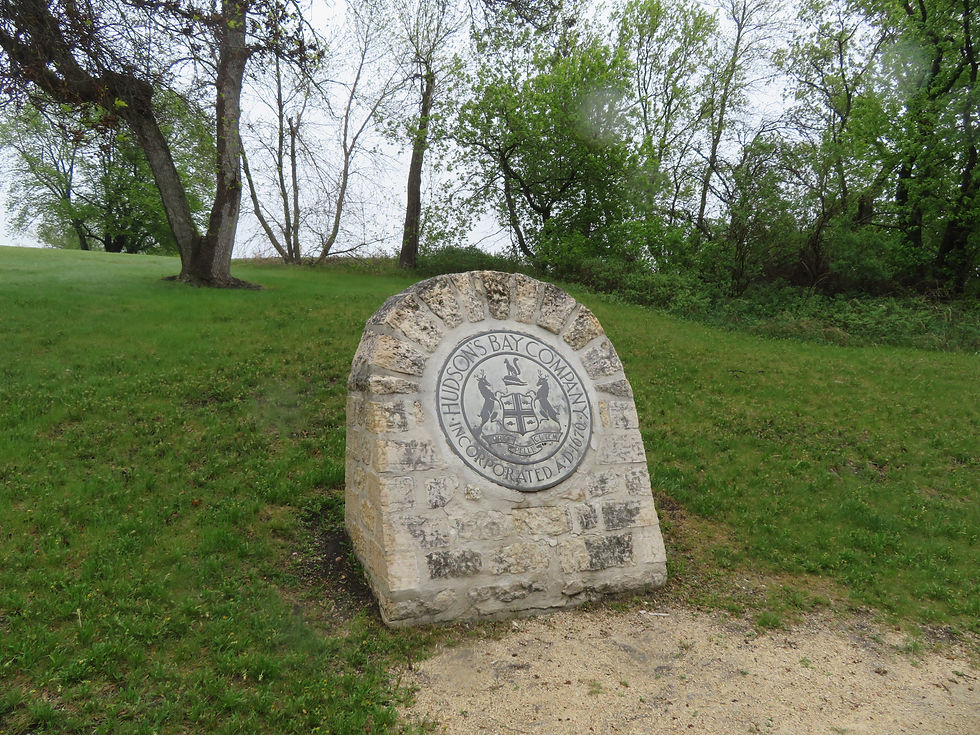
We are forced to wear our warmest gear when walking through the Hudson's Bay Company - built historic Lower Fort Garry. We note ironically the large plaque commemorating HBC's 1670 incorporation, given its dissolution in recent weeks. There are frost warnings the next two nights, with a daytime high of only 6⁰c, only 2 days after the mercury hit 33⁰c here. I note that the average of those two values is indeed exactly the 18⁰c historical average it is supposed to be here, after adding 1.5⁰c for global warming. But I guess 6⁰c counts as spring when winter regularly hits minus 30⁰, and requires plugging in cars left outside overnight so that they can start the next morning. I've clearly gone soft from my Montreal upbringing, after 2.5 decades of Vancouver living. Yet living in Manitoba certainly demands even greater mental fortitude. Soon it will be back in the 30s, but with swarms of biting insects to boot. It rains for about 36 hours non-stop. The bone-chilling winds continue for another afternoon beyond, which we spend visiting Hecla Island and provincial park.

The first car that I could truly consider as my own was our 1985 white Toyota Camry, which my parents functionally gave to me when I started my internal medicine residency, aged still just 23, July 1992 at UConn down in Hartford, Connecticut, driving off with my windsurfer atop, bicycle behind, and all my clothes and other stuff in the backseat. With me in the States on a J-1 student’s visa and using a Quebec driver’s license, it was easier to have it officially remain my Dad’s car, rather than go through multiple formalities.
Although by no means was it considered mine, I had been driving it a fair amount in the previous seven years, probably more than anyone else of the four of us. By chance, the month we purchased it, my father had a significant case of Guillan-Barre and was mostly bed-bound for a few weeks [but did not require hospitalization], so I had the opportunity to drive it to school [mostly I took public transit, at least until the later years of medical school, once having started in the hospitals] when it was brand new, and take friends to lunch at Montreal’s iconic Orange Julep on an occasion.

The Camry also made countless late night visits to Lafleur’s, a standout among Montreal’s many greasy hot dog and frites joints. Even more memorable were its 2am one-hour, post Friday night out intentionally without alcohol, drives to our country house in the Laurentians, which I would generally have to myself. Often I would go over to my friend Andy’s country house, a half-hour away on two lane country highways, for windsurfing. Now living in Vancouver and Toronto, respectively, we realize how good we had it, with Montreal’s equivalent of “cottage country” being in such close reach. Later the same destination turned into a seven hour post-work drive, at times with my girlfriend Stella, up from Hartford, stopping only briefly in Montreal to say hello to my parents, and returning down Sunday night. Looking back, I don’t know how I was able to do it, I distinctly recall, on one occasion, alone on the way back, starting to nod off and swerve off the road before something jolted me back to attention.
Such, at least, was never a risk when driving in the snow, something done without thought in Montreal and much of Canada, but not in Hartford [or now in Vancouver]. In Connecticut, one individual in the far east of the state would see a single snowflake, call the radio station, and a “Nor’easter” would be declared, with the whole state coming to a virtual standstill. One of the funnier episodes from my residency related to a letter I received from the program director, about a week after one of these storms. I had gotten up, it was snowing lightly, and had headed into work. Many SUVs were stuck on the sides of the road, but the Camry, with its Montreal snow tires plowed straight through the light dusting covering the streets, and I arrived no more than my usual few minutes late.

On the overhead speakers at the hospital [I can’t recall if it was Hartford Hospital or St Francis’ at the moment] repeated emergency situation announcements, “Dr. Timothy, Dr. Timothy!”, were being made. The hospital had an unusual set of codes- fire was “Dr. Rover!”, named after a dog who helped save the hospital from a fire years earlier, cardiac arrest was “Dr. Rush Pace!”- I always imagined two old ladies sitting in one of the hospital’s waiting rooms, commenting on how appropriate that doctor’s last name was, given how busy he seemed to be, always getting called to different wards! The overnight staff was not being allowed to go home, as many members of the morning shift were unable to make it in, others being driven in by the police. I went about my day, nothing special. Then the letter arrives: “Dear Stuart, it was noticed that during the recent snowstorm you made the extra special effort to make it in to work…”, I fell to the floor in laughter!

Getting home could also be a problem in the snow. Waiting for a light, the traffic wasn’t moving for several cycles as the cross street’s traffic would take up the intersection each time. Those clueless Connecticut drivers! So I got out of my car ran the several lengths up to the intersection, and then, when the far side of it filled up, I walked into the intersection and stood in the middle, physically blocking any more cars from entering. When the light turned, I ran back to my car and drove the few lengths that had been freed up. Repeating this 2 or 3 times, and I was through the intersection, with another story to tell my Montreal friends later that evening!
The Camry was a great car, although seeing a picture of it recently, I was surprised to see

the amount of rust on the frame ringing the wheel after a decade of Montreal winters, a near inevitable problem back then. By the time I purchased the Celica in 1997, the best I could get for the Camry was $400. On asking the dealer what would be done with it, he told me it would it would probably get shipped to West Africa. This put an image into my head of a child soldier in Liberia or Sierra Leone standing through its sun roof with a machine gun. Not what I wanted as a possible outcome for it. So my Dad sold it to my friend Nelson’s girlfriend for $1. About a year later she totalled it on the lower level of Decarie highway. The Camry only really failed me once. On a

highway outside Buffalo in early 1992, driving back from an interview in Pittsburgh, suddenly when I pressed the gas petal nothing happened. I coasted to a stop on the shoulder, and had to spend the night at a motel before the timing belt could get replaced. It also had some sort of recurrent problem resulting in flat tires when I was in Hartford, resulting in my becoming very proficient at changing them. I recall on one occasion only being minutes late for a date. Those were the days!
When one looks at the map of Manitoba, one sees what looks like a skinnier twin of Lake Winnipeg to its west. This actually is composed of two separate lakes, Winnipegosis [meaning "little muddy water" in Cree], and south of it, Manitoba. Together, the three have been termed "The Great Lakes of Manitoba". As we had both previously been to the city of Winnipeg, and generally prefer to avoid large cities, we had opted instead to spend a few days exploring Manitoba's Interlake region, figuring that we were unlikely to be in the area again.
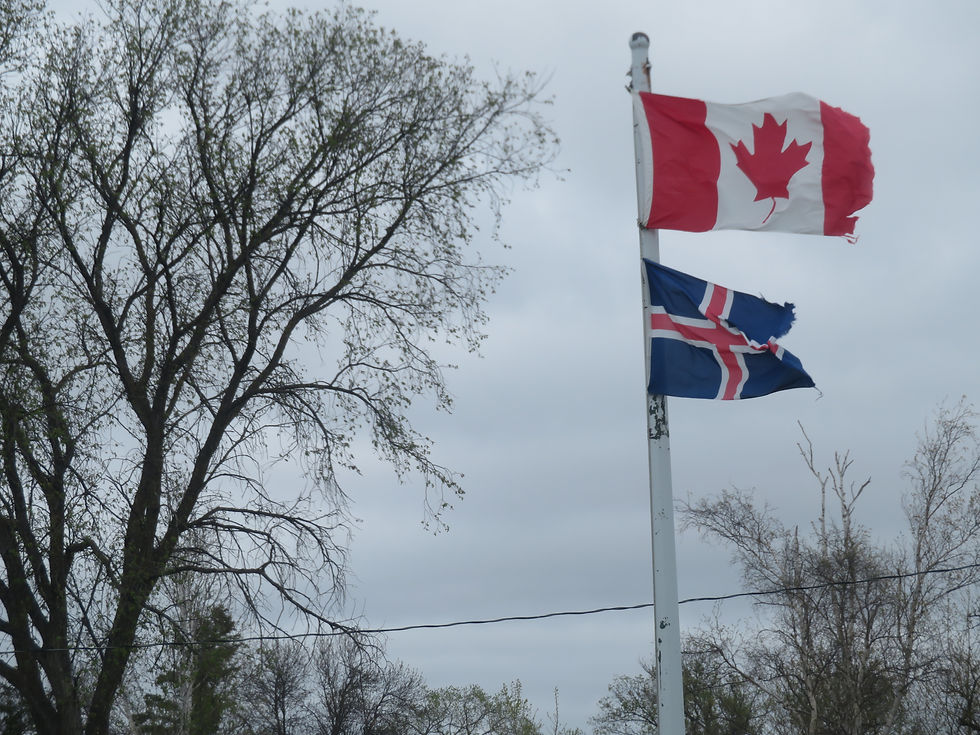
We based ourselves in Gimli, across the lake from Grand Beach. Upon hearing where we are staying, my Mom recalls the 1983 Gimli Glider incident, when an Air Canada jumbo jet ran out of fuel mid-way from Montreal to Edmonton, due to a combination of a faulty fuel gauge indicator [just like our Volvo!] and an erroneous manual calculation [never happened to us in over a decade!], forcing the soon-to-be heroic, glider-experienced, pilot to glide it against the odds [simulator recreations all failed] 17 minutes without fuel or power into Gimli, without any major injuries and only minor plane damage. The area has a strong Icelandic heritage, with as many such flags flying as Maple Leafs [the Toronto hockey version of which just lost round two in game 7, leaving Edmonton as the last Canadian team standing entering the conference finals] , and the province having the world's largest Icelandic population abroad. In fact, in the late 1800s the area was known as “New Iceland”, and was functionally independent from the Canadian government.

Roads here are as long and straight as a geometry teacher's dream, often of limestone gravel. Driving them at distance-required, and speed limit-permitted, 80-90 km/h, I coin the term "Manitoba Mountains" for the frequent, and unexpectedly high, hazardous, heightened rut-walls that seem to regularly develop mid-lane along them. The region's limestone is most impressively on display at Steep Rock, where a series of low carved cliff formations exceed our BC-derived pessimistic expectations.

On the way, I visit the Narcisse Snake Dens [while JC opts to stay in the car], where the need to winter in the shelter of cracks and caves in the limestone ground make it home to the world's largest concentration of snakes. Although it is the perfect time of the year to see them emerging, and mating in snake balls, the recent cold weather means only a hundred or so are out, as opposed to possibly tens of thousands of the red garter snakes the prior week. We cross westward at The Narrows, the only place where Lake Manitoba can be crossed by a bridge, actually a remarkably short and unimpressive one given that feat. Soon we are shocked to see what looks like a dark line at elevation in the distance- it must be clouds deceiving us... no it's a real mountain! In Manitoba!

Maybe we shouldn't be surprised, given that our destination for the next day is Riding Mountain National Park, where, although we strike out at its famed bison-enclosure, we enjoy a fat-tired bike ride along a sandy lake-side trail and see three bears roadside, the last with a baby who climbs and later descends a tree while we watch. Manitoba has another mountain range as well, both formed as escarpment from glacial scouring along the edge of the pre-historic huge Lake Agassiz, with all the above lakes mentioned, as well as Lake of the Woods, being its remnants.

I had gotten my driver’s license soon after turning sixteen, about a year before my parents purchased the Camry. The first car that I ever drove was our wood-panelled 1980 Pontiac Bonneville station wagon, which my Dad let me drive for a few minutes after pulling off on the shoulder of the old quiet two lane highway 117, in the Laurentians. Those station wagons were huge! I still lament the fact that fashion has led to SUVs taking over their role as the car of choice for the hordes of soccer moms who never leave asphalt-paved roads, especially when I’m stuck behind one of them with my view beyond obstructed. Although I generally drove our other car, the station wagon’s tank-like size and structure also made it the car of choice to drive to Cegep during the weeks when my right lower leg was in a plaster walking cast with an extended heel, after having been fractured in a check during a game of ball hockey. The concern was for fear of a more significant accident if my heel slipped off the brake [which never occurred] in the much smaller Camry.

However the car that I mostly drove during that first year was our beige 1977 Chevrolet Caprice Classic, which apparently was the best-selling car that year. It also had its quirks, I recall having had to frequently open the carburetor, under the hood, in order to get the right air/fuel mix to get it to start in cold weather- a technique taught to me by my Mom, although she didn’t remember such at all on discussing it now. My parents sent the Caprice Classic onwards when they bought the Camry in 1985. Could it have made it to Hollywood? Months later there it was! Driving the wrong way on the Los Angeles freeway in a hair-raising car chase in the action film “To Live and Die in L.A.”, which you can still watch on YouTube right now!

My parents other car that I drove occasionally in my youth was a 1988 Honda Accord, which replaced our station wagon. It was much more powerful than the Camry, and it was in it that the specific speeding exploits that I opted against mentioning for one-upping Volvo-purchasing Raj occurred, driving back on the 401 from a weekend visiting Western University. While detailing them here would be of interest for this piece, the ages of my nephews and the sons of my implicated friend prevent me from doing so for the time being.
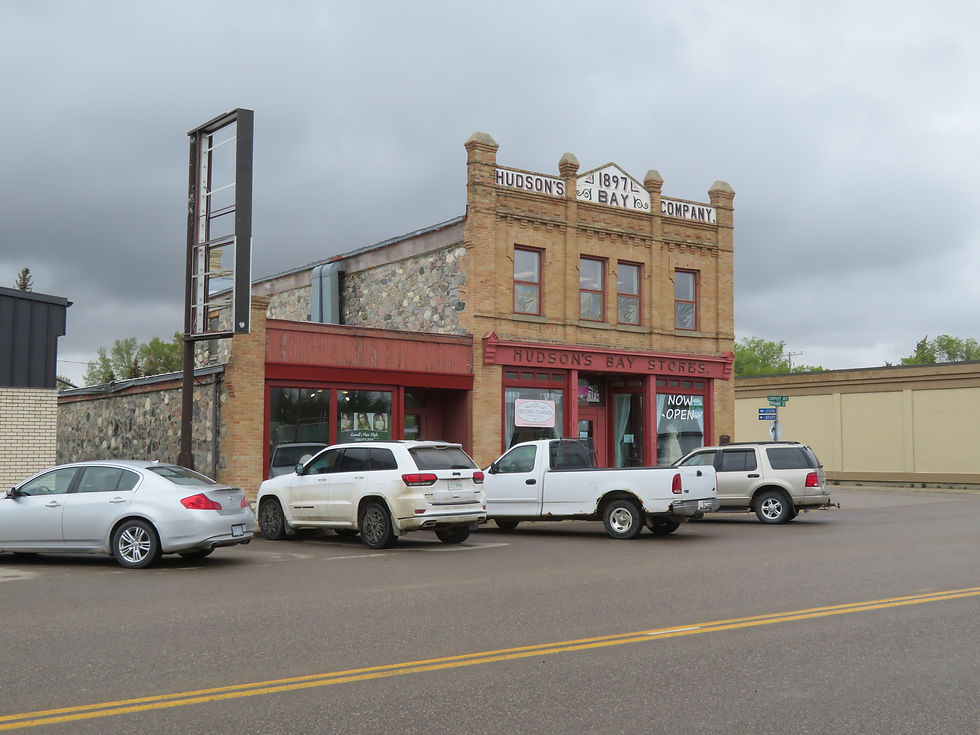
From conception, our trip plan was to concentrate on “Northern” Ontario and Manitoba, and then drive rapidly through the, closer-to-home, three more westerly provinces. Saskatchewan, although its reputation is of being flat, is actually much less so than the flat parts of Manitoba, with most of the province consisting of undulating low hills. Suddenly, there is a beautiful river valley in front of us, with a town between large lakes and even a low ski hill on the far side- Hudson’s Bay Company- established Fort Qu'Appelle and its glacially-derived, 180m deep, valley. We decide this is the place for our unplanned stop of the day, and we are not disappointed. We find a wide main street with an 1897 Hudson’s Bay Company brick storefront, and then stop in at the Valley Bake and Coffee Shop, which ends up being the town’s famous, historical painting-walled, place to be. Next door, “Becky’s Place”, selling First nation’s gifts and paraphernalia, is just as interesting. We then go for a short walk along the river to Echo Lake, and finally stop in at the town’s excellent small museum.

The most dramatic sights on driving through the province, however, are Saskatchewan’s “mountains”; its tall, humongous, grain elevators. From a distance you could almost swear that there is a fairy tale castle in the middle of the highway rising up on the horizon in front of you, above the surrounding lands. Although their numbers, especially of the iconic older wooden ones, are in decline, they, including the more modern versions, remain a highlight of the Canadian prairies.

We spend the night in Moose Jaw, where I am disappointed to learn that there is no good story to the etymology of the city’s name, with the most likely explanation being a similar sounding Cree word. Nevertheless, Moose Jaw is the home of Mac the Moose, the world’s largest moose from his 1984 construction until surpassed by a Norwegian statue in 2015, and again since 2019 when his antlers were extended to regain the title. We visit him on the way out the next morning, with another long cold and rainy day of driving planned, heading for our hotel near Calgary’s airport, avoiding the city.

The first car that I remember was my parent’s light blue 1966 Acadian Beaumont, given to them by my grandfather as a wedding gift that year. Although I have no recollection of them, my parents now claim they put stickers of flowers on it, stating that they were “flower children without the pot” [my Mom did have ponytails, and we did some camping, but otherwise I find this revelation surprising]. What I do remember is that it had “air conditioning through the floor” with a large hole there [another victim of Montreal winters and road salt], potentially allowing for attempted braking Flintstones-style! My Dad mentions that it would stall “every time it went through a puddle”. On questioning him further, it seems that somehow water splashing along the undercarriage repeatedly led to the car stalling about 10 feet later, requiring about a fifteen minute wait before it could be restarted, with several trips to the garage failing to fix the problem.

The one western pre-planned destination for our drive was Jasper- I wanted to see what things were like there after its devastating, national-headlining, fire last summer. Starting very rapidly on July 22nd, 2024, within hours the entire town of 25000 was being evacuated, and 358 of its 1,113 structures ended up being destroyed. At a cost of $1.1 billion in insurance claims, it was among the most expensive natural disasters in Canadian history [the 2016 Fort McMurray fires, which

destroyed 2579 houses in the much larger city, tops the list at $9.9 billion]. Amazingly, the fire however only caused one death, 24-year-old Morgan Kitchen, a firefighter hit by a falling tree.
We had decided on driving up from the south along the spine of the Rockies through the amazingly beautiful and contiguous Banff and Jasper National Parks. Although we had done this before, neither of us had done it in the spring, when there is more snow on the mountain tops. This three hour route [if one somehow manages not to stop at any of the amazing viewpoints] is truly one of the world’s premier drives [regardless of season], something that everyone should try to do once.

In addition to many quick photo stops, we also did the unmarked hike to stunning Hector Lake for our day’s exercise, which we end up having all to ourselves! I had caught a glimpse of it from the highway, then saw a single car parked in a small roadside pullout, leading me to U-turn and investigate further, finding the trailhead. About 40km south of Jasper, we began seeing burned-out trees covering the mountainsides. At first I thought that they must be from an unrelated fire, however as the stretch continued unbroken, it soon became clear that the devastation was all from last year’s monster. Despite such, on getting closer to town we are surprised to see a few destruction-surrounded lodges intact, with the town’s residents later telling me that, understandably, special efforts were made to save these.

In town, essentially all of the destroyed homes and buildings have been removed, with multiple large, fenced-off, dirt areas containing pits where foundations had been. Nearby stand several large parks of temporary trailer housing for the unfortunate third. I stop the sixty-something year old, more fortunate, Chris, out on his bicycle, in hopes of a chat. He tells me stories of calling his wife at work and telling her to get out. He also points out one house standing intact with a rooftop red hose right next to a fenced-off area, and directs me to a partially-still

standing nearby church for further viewing. With only a few low stone walls and a steeple topped by a charred spire in a mostly empty lot, the St Mary & St George Anglican Episcopale Church [double-named to satisfy the two disagreeing main donors- apparently neither saint was of much help against real forces] looks like a centuries-old ruin in Europe.
Chris also had some harsh words for Parks Canada, which serves as the functional government for the national park-enclosed town. He felt that not only were they slowing the recovery efforts through placing additional hurdles related to “contamination” issues, but, at the same time, had been partly to blame for the extent of the fire, commenting "every local knew it was coming, but the National Parks were hesitant to do anything that might reduce the visual beauty of the park". Nevertheless, Jasper is once again open for business, with a hopping main street full of restaurants staffed by returned evacuees.

As this piece makes clear, I have greatly enjoyed much of the driving I have done over the years. With the right bit of classic rock playing on the stereo, it can make for stimulating or even thrilling recreation. However a considered reading of the piece also shows why humans driving themselves may not have much of a future. My family and friends have been fortunate to not have had any motor vehicle accident-related deaths, however that doesn’t mean there haven’t been any close calls.
One of those incidents, which I refer to as “My Zaida’s Last Hurrah”, was particularly funny. My sister and I always used to make fun of our Zaida [Yiddish for “grandfather”] driving us around when my parents were away, telling others that if he wasn’t sure whether to go straight or turn left, he’d split the difference and head for the gas station on the corner [I don’t think that ever really happened, beyond possibly momentary hesitation].

Nevertheless, he did make it all the way down to Florida and back twice. In his mid-80s, he was driving his wife, and my other grandmother, when he tried to brake “and suddenly the car took off!”, hitting a building on the corner. All of them were ok, allowing us to make fun of this incident, after which he surrendered his license. What makes it so funny, however, was what the building on the corner he smashed into was- a funeral home! Three Octogenarians trying to get inprematurely!
Another incident was much less humourous, an older cousin, Dubby, from New York, spent weeks in a coma in Scotland after her husband was in an accident, possibly contributed to by difficulties driving on the opposite side of the road in the UK.

Although I now routinely go back and forth between different sides of the road with frequent driving in the UK, and Malaysia [both on the left], I did have a roll-over driving on the opposite side in New Zealand many years ago, although I don’t think such was a factor. Nearing the end of our 8-month around the world trip, Stella and I were headed for an early morning guided tour on the Fox Glacier, when I lost control of our small rental car on a curve of the slippery, thin, empty two lane highway. I corrected the initial skid, but failed to correct the resultant counter-swerve, we went into the ditch sideways, and the car slowly rolled on to its right side, and then came to a rest on its roof. We were both buckled in- after confirming we were both ok, we released our buckles, fell to the top, got out and hugged. Ironically, we later notice that there was a poorly-placed billboard advertising the very tour we were headed to take along the dangerous curve in question- had I momentarily looked at it, leading to my failing to follow the bend of the thin road?
The only witness was a cow in the adjacent pasture, who began to loudly and repeatedly

moo, as if recognizing something was very wrong with the world [had we passed through a portal into an alternate reality? Shortly afterwards a hockey puck skips over Wayne Gretzky’s stick facing an empty net, resulting in Canada’s losing the World Cup, and Stella and I break up]. All the car’s panels were dented, but after having it towed and getting the radiator repaired, we had to drive it 400km over the spectacular, but at times hairy, Arthur’s Pass, in order to get it to the nearest outlet of the rental agency in Christchurch. After returning home, I pause before pulling out of my parent’s driveway onto a road for the first time- indeed my first tendency would have been to go onto the wrong side! Stella later told me that she actually did so.
I have now driven rental cars in approaching fifty countries, and aside from hassles dealing with agencies that seem to always be trying to scam you with compulsory hidden costs [Mexico being especially noteworthy for such], it has been a very enjoyable method of independent travel. It is probably the best, and at times the only, way to see the more remote towns, countrysides, and coastlines, which I feel make up the true character of most places. On the other hand, in the large cities, much like back home, one is better off without a car, or just leaving it parked at the hotel, and getting around via public transport or taxis. Usually we will just rent the cheapest and smallest car available [advantageous for narrow, winding, streets in many old towns, especially in Europe].
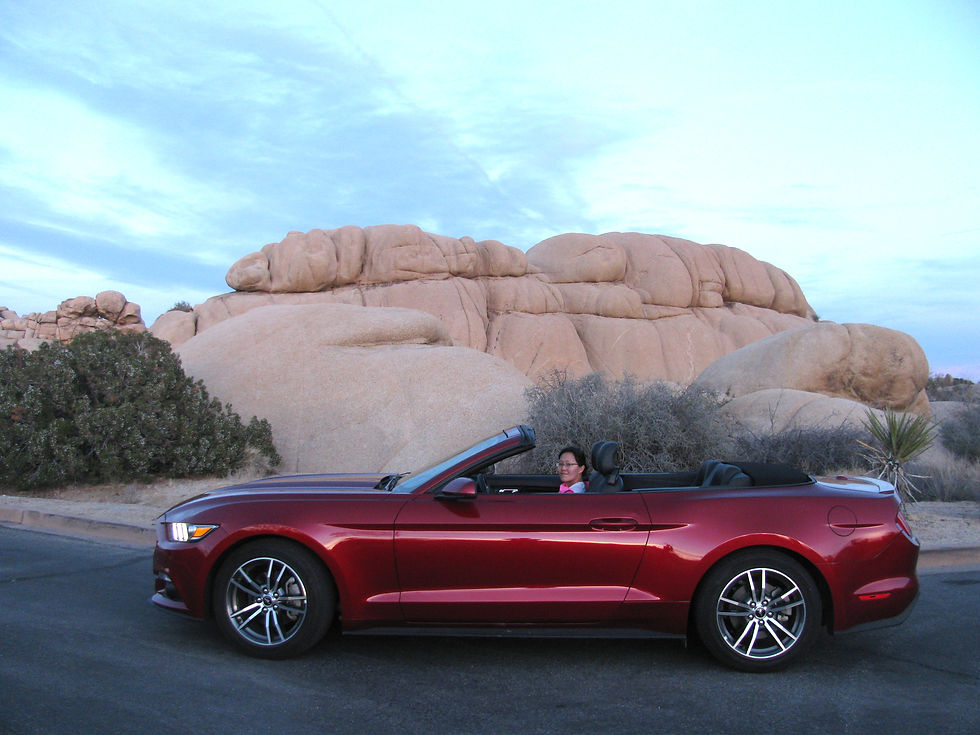
However when we have been in Southwest USA, California, Florida or Hawaii, I must admit to a special thrill from splurging on a convertible, driving top-down with The Eagles’ lyrics in my head: “Ventura Highway in the sunshine… 'Cause the free wind is blowin' through your hair”. In reality we don’t quite live up to the song, Jiak Chin’s hair is usually bundled up along with the rest of her, while I drive with a baseball cap on in order to protect my balding scalp, refusing to acknowledge the usually lower than desired air temperature of the moment.
On our last such trip in Phoenix, late 2024, we see a strange looking car with some sort of a crown-like sensor device on top. It is a self-driving Waymo taxi car, the descendant of Google’s pioneering such project, with a LiDAR unit on its roof. We end up seeing about a dozen of them, which are now available in several southern US cities. A quick search shows that they reduce various types of accidents by at least 80%. Car accidents kill about two thousand Canadians, and fourty thousand Americans annually. Worldwide over one million.

They are the leading cause of death among young adults, and a leading cause of preventable death at any age [although dwarfed by the completely without benefit act of smoking beyond young adulthood]. Although an eventual switch to self-driving cars has been talked about for some time now, and seems to be occurring slower than predicted, it seems to be inevitable eventually. It is hard to debate that it will be the right thing for society to do. Like for much else however, the march of technology will be eliminating another something special. I just hope it doesn’t occur in the next couple of decades, before my hoped-for retirement driving adventures are done.

After dinner in Jasper, we head along the Yellowhead Highway an hour into British Columbia –home!- in order to shorten our upcoming long last day of driving. We stay at the Fraser River-side Tete Jaune Lodge, and are told that the close by, now largely abandoned, town of the same name was actually Canada’s largest settlement [but not city] west of Winnipeg with a thriving population of 3500 during construction of the railway in the early 1900s. Both it, and the highway [tete jaune literally means “head yellow” in French] are named after a blond-haired metis HBC fur trader and explorer named Pierre Bostonais, nicknamed “Tête Jaune”.
We also saw quite a bit of wildlife going through the Rockies’ parks and into BC. Three more bears, for a total of seven on the trip, all in national parks. We also saw a group of four bighorn sheep roadside in Jasper NP, and two young male elks and then two moose, both shortly after entering British Columbia. We had seen a female moose smartly waiting to cross the highway on the way to French River Provincial Park at the beginning of the trip, but she was gone before we could get a picture. We were surprised to have not seen any afterwards, despite routinely looking at the banks of countless small roadside lakes and marshes through Northern Ontario in the hopes of spotting one. This time we managed to get a good shot of one of the two females. We certainly saw over one hundred beaver lodges, mostly roadside, although we each only had a separate brief sighting of a beaver swimming, mine from a kayak in Byng Inlet, JC’s from her bike in Riding Mountain NP. We had a couple of fabulous roadside fox sightings, and several of what were more likely coyotes running across agricultural fields in the distance.

As far as insects go, the near absence of mosquitoes, and rarity of flies were very pleasant surprises, a situation that has probably already changed dramatically by the time of my typing this a week after getting home. The main insects of concern for us were actually the much scarier ticks, with reported Lyme disease cases across Canada increasing from under 200/yr before 2010, to now over 4000/yr per Health Canada’s website, mostly in Southern Ontario. One tick dropped on to my arm when we hiked with Nelson in a high prevalence area near Kingston the day before starting the cross-country drive, and the next day Jiak Chin noticed an unexplained bite on the back of her neck. Fortunately it did not progress into a rash, and given the short time span and lack of tick [fed or otherwise] seen on her, we did not get too worried.
However, out of nowhere, two-plus weeks later, she caught a tick walking right next to that very spot along her neck-back hairline in our hotel in Calgary, despite no hiking at all that day, making us both go a little crazy. Once again it seemed to be unfed [although she wondered if it could have just again gotten smaller by then, and criticized me for killing and throwing it out, rather than keeping it for analysis], and no bite or rash or other symptoms developed, so we are trying to forget about it as of now. But how did it get there? Had it been hiding in her clothes or hair for a day or more? Or a resident of the modern airport hotel? It seems fear of ticks will be an increasing concern for any of us enjoying the outdoors as climate change continues. It will be a much more significant issue for any of you who have a dog that you take hiking with you- they can get Lyme disease as well.
Our last day is only about driving. As it is a Friday, we decide to have an early dinner and fill up with gas in Hope, 150km east of Vancouver in the hope [no pun intended, but I’ll leave it in rather than looking for a synonym!] of avoiding rush hour traffic and higher gas prices closer to the city. Neither works according to plan. Although we are going against the exodus, we still have about an hour added by traffic jams, making arriving home the only unenjoyable stretch of our 19 day adventure. In all we drove 6152km, about 150 of them done by Jiak Chin! If one were to drive from Toronto to Vancouver without any detours, the distance would be ~4360-4390km, depending on whether one takes the slightly shorter, but at least five hour faster [assuming no border problems!], route through the States. The gas story ending is no better. In total we spent $841.42 on car fuel. We were very lucky to have not had to spend considerably more, with not only the price of oil be currently low, but the federal government having just eliminated the carbon tax. The prices we saw ranged mostly from $1.12 to $1.43 per liter across Ontario, Manitoba, Saskatchewan and Alberta [where we made sure to fill up in Jasper, in anticipation of BC-pricing], with our bills consistently around $70-something. In Hope, we were shocked to see all gas stations-and we checked several- at $1.71/L and had to fork out $106.65- welcome home!
A few days later I get the provincially-required inspection for an imported car. Adomas calls the Infiniti “a real beauty!”. He is, of course, correct, my parents have kept it in great shape, following the recommended maintenance schedule. However unlike my last few cars, the silver Infiniti looks like every other second car on the street, and I miss the character of my past cars. Later the same day, we go into the Autoplan broker, bringing along the transfer and gift forms that my father signed, as well as his original bill of sale, showing that he paid tax on doing so [otherwise we would have been required to pay tax on its current value], as well as the car itself in order that they may verify its engraved vehicle identification number is as stated. We get it registered in BC and receive our new license plates. The Infiniti is ours! After fourteen and a half years we finally have a new car. It currently sits in our condo’s garage, with a successfully disconnected battery, untouched for over two weeks with no upcoming usage planned!
Note: Raj, Adomas, and Jodie’s names have been changed to protect anonymity.
Thank you to my parents for filling in some of the history related to their cars and other matters, not to mention the Infiniti, Camry and everything else!


Comments